A field-informed perspective on decision rights, human agency, and responsible autonomy in supply-chain operations.
THE SCENE
At 9:12 on a Tuesday morning, a planner saw the problem before anyone else did.
A critical component would miss its connection. Production had perhaps six hours before the disruption became a line stoppage. The planner had already checked the alternatives: move a smaller quantity by air, rebalance stock from a nearby plant, and protect the two highest-priority customer orders. The cost was within the weekly variance the business routinely absorbed. The operational answer was clear.
Still, she did not act.
The premium-freight exception needed her manager. Her manager needed the business-unit head because inventory would cross a regional boundary. Finance wanted confirmation because the expedite would appear against a different cost center. By the time the fourth person approved the move, the earlier flight had closed. The same decision now cost more, arrived later, and required an executive escalation.
Afterward, the organization called it a logistics failure. The planner called it Tuesday.
This pattern is familiar in large enterprises. A person close to the signal can identify the right response, but the operating model sends the decision upward. Each approval looks prudent in isolation. Together, they create a system that is slow by design.
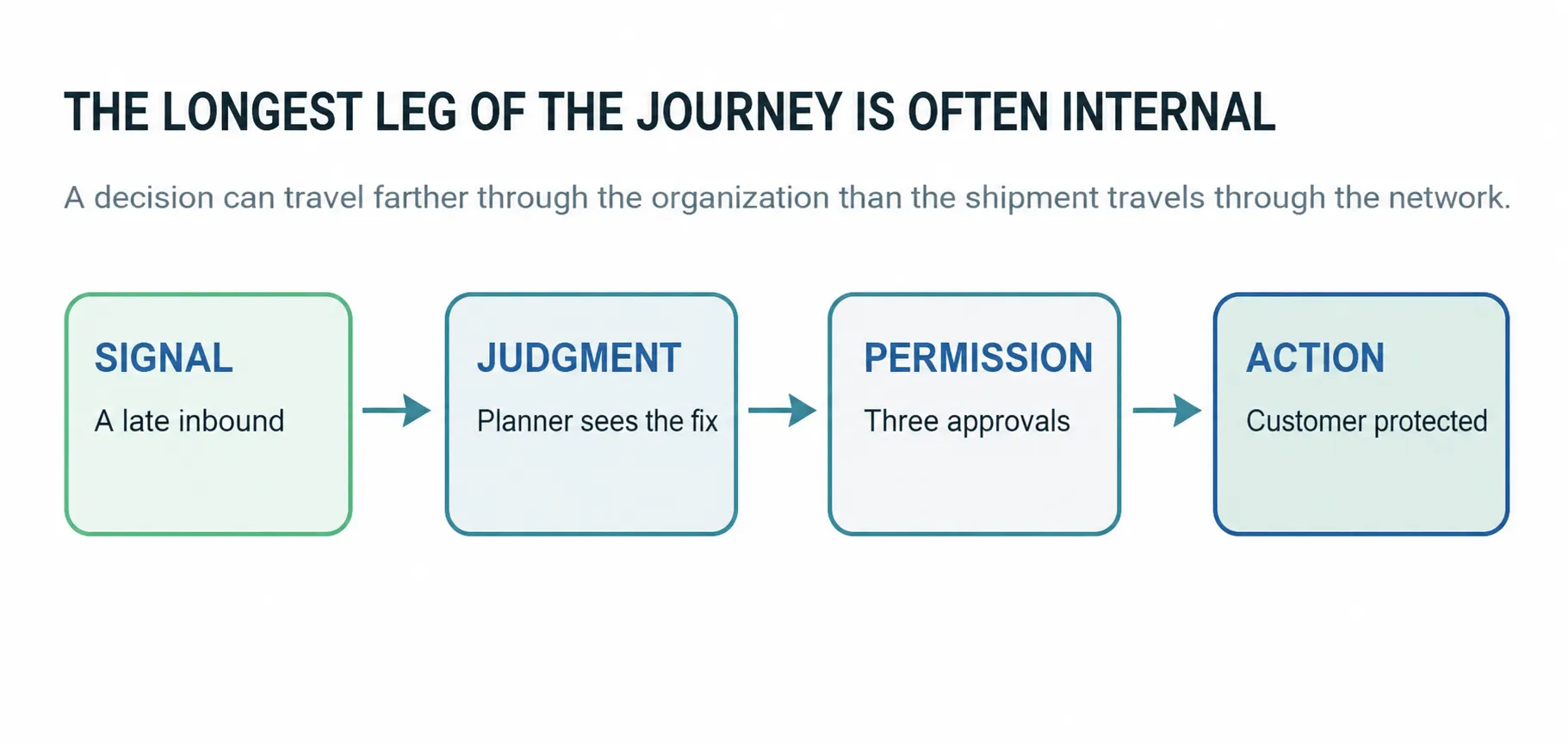
The most expensive part of the journey may not be the physical movement of goods. It may be the internal distance between insight and authority.
The quiet cost of “one more approval”
Approval is often treated as a control. In practice, approval can be a transfer of ambiguity. The person closest to the facts makes a recommendation, but someone farther away accepts the formal accountability. This feels safe because it creates a visible checkpoint. Yet the checkpoint may add little new information and consume the one resource the supply chain cannot replenish: time.
The direct cost is easy to see: detention, premium freight, lost production, excess inventory, missed service. The deeper cost accumulates more slowly.
· Decisions migrate upward, even when the relevant context lives at the edge.
· Managers become routing layers for routine judgment instead of coaches for exceptional judgment.
· Teams learn that waiting is safer than acting, especially when a fast decision can be punished but a slow decision is explained as process.
· Policies remain static because repeated approvals mask the fact that the same exception is no longer exceptional.
A company can have talented people, modern systems, and near-real-time data, then convert all three into yesterday’s answer through its decision architecture.
The replenishment rule nobody trusted
At a consumer-products company, a regional planning team had a replenishment recommendation that was right often enough to be useful, but not trusted enough to execute. Every morning, planners exported the recommendations, adjusted them in spreadsheets, circulated a summary, and waited for a manager to sign off. One experienced planner told a colleague, “I can predict which recommendations will be approved. I still cannot release them.” The team was not short of insight. It was short of delegated authority.
How capable people learn not to decide
Organizations rarely announce that judgment is unwelcome. They teach it through consequences.
A planner who acts inside an ambiguous boundary and is challenged afterward becomes more cautious. A manager who is measured on preventing variance asks to review more exceptions. A finance partner who sees only the cost of action, not the cost of delay, requests another check. Each response is rational. The combined behavior creates organizational learned helplessness.
This is not a motivation problem. It is an operating-model problem. Employees adapt to the incentives around them. If the safest career move is to escalate, escalation becomes the default. If accountability is personal but authority is distant, ownership becomes ceremonial.
The truck that waited for a meeting
A distribution leader described a recurring carrier-capacity issue that appeared every Friday afternoon. The local team knew which secondary carriers met safety, cost, and service thresholds. Yet procurement policy required a weekly review for any allocation change. Loads rolled into Monday, service degraded, and the operations team held a call to explain why. The meeting did not resolve uncertainty. It institutionalized a delay everyone could already predict.
AI exposes the contradiction
Enterprises now talk confidently about autonomous planning, agentic workflows, and AI workers that detect, decide, and act. But autonomy cannot be layered onto an approval culture unchanged. An AI agent that must wait for the same chain of human permissions is not autonomous. It is a faster analyst trapped inside the same slower organization.
The challenge is not simply to give AI more freedom. It is to redesign decision rights for people and machines together.
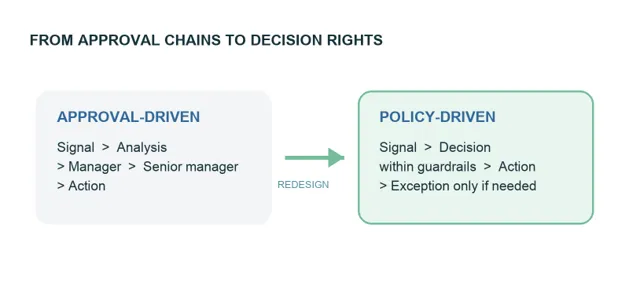
In a policy-driven enterprise, a decision does not climb a hierarchy merely because it matters. It follows explicit boundaries. Within those boundaries, action is expected. Outside them, escalation is immediate, informed, and proportionate.
Governance is not the brake. It is the steering system.
When an exception becomes a policy signal
In an industrial network, planners repeatedly expedited the same family of parts after supplier variability crossed a familiar threshold. The organization treated every expedite as a one-off approval. A better design would recognize the pattern: if the supplier-risk score, inventory exposure, and customer priority meet agreed conditions, authorize the response automatically and review the policy outcome weekly. The exception then becomes evidence for better governance, not another task in a manager’s inbox.
A practical autonomy ladder
Autonomy is not binary. Responsible organizations increase it in deliberate stages, with stronger evidence and controls at each step.
- Step 1
Recommend
The system proposes; a person decides. Use this stage to test decision quality and reveal unclear policy.
- Step 2
Act with confirmation
The system prepares the action; a person confirms high-impact or novel cases.
- Step 3
Act within guardrails
Routine decisions execute automatically inside explicit thresholds. Exceptions route to the right owner.
- Step 4
Optimize and learn
The system adjusts choices across connected objectives while governance monitors drift, impact, and policy fit.
What leaders must change first
The path to autonomy begins before the technology. It begins with a candid inventory of how the enterprise makes decisions.
Find the repeat approvals. Look for decisions that are approved almost every time. They are strong candidates for explicit policy and delegated authority.
Price the waiting. Measure not only the cost of a wrong action, but also the cost of delayed action, lost options, and escalating coordination.
Move authority toward information. Place decision rights where context is richest, while keeping risk ownership and review visible.
Separate reversibility from impact. A reversible inventory allocation should not travel through the same governance path as a safety-critical supplier change.
Design human and AI roles together. Clarify who senses, recommends, decides, executes, observes, and can intervene.
Reward responsible action. If people are praised for escalation and punished for bounded judgment, no autonomy program will survive contact with culture.
The leadership question
For years, enterprise control was built around the assumption that information traveled upward and authority traveled downward. Digital networks changed the speed of information. AI will change the scale of judgment. The remaining constraint is the design of authority itself.
The goal is not an organization where leaders disappear from decisions. It is an organization where leaders spend their attention on the decisions that genuinely require leadership: policy, trade-offs, ethics, uncertainty, and consequences that cannot be delegated safely.
Your best employee may already know what to do. Your next AI system may know as well. The defining question is whether the enterprise has built the confidence, clarity, and governance to let either of them act.
Share this article