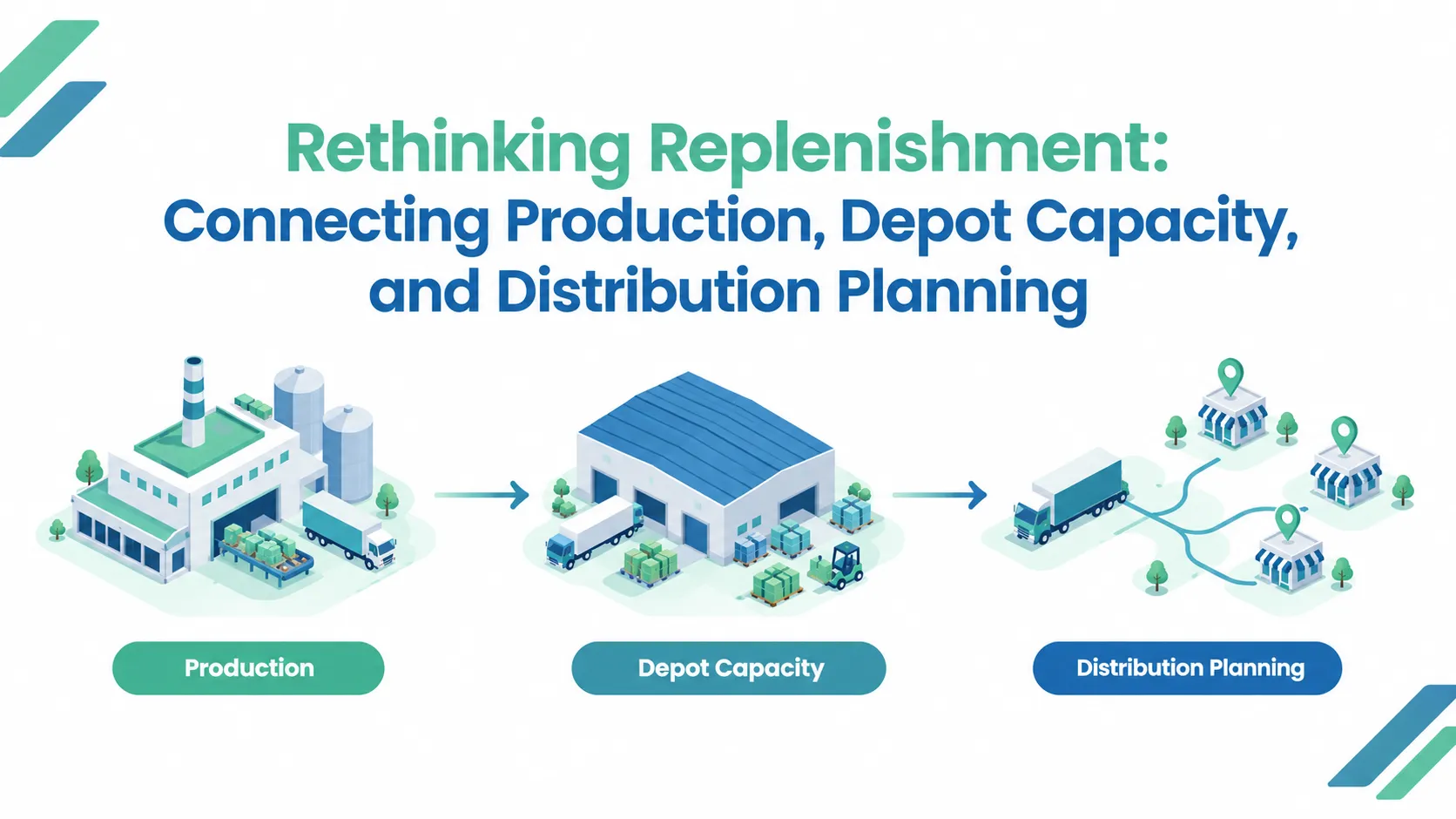
Every replenishment plan makes a promise: the right stock, at the right depot, at the right time. Keeping that promise depends on three plans working as one — what the plant produces, what each depot can actually receive and hold, and how stock moves between them. When these three plans are built together, replenishment becomes the steady engine of service, working capital and logistics efficiency.
In conversations with manufacturers and distributors across lubricants, automotive components, FMCG, food and consumer brands, one theme comes up again and again: replenishment is still treated as a reorder rule at the end of the planning chain, rather than a network decision at its centre. This article looks at where production, depot capacity and distribution planning need to connect, what connected replenishment looks like in practice, and how to get there step by step.
Why Replenishment Needs a Rethink Now
Supply networks have grown more layered. A single product may move from a plant or contract manufacturer to a mother warehouse, then to regional depots or C&F agents, and finally to distributors, dealers, stores or customer-side VMIs. Each layer holds stock, each has its own storage and unloading limits, and each is planned on its own calendar.
Meanwhile, demand has become faster and more regional. Festivals, weather, promotions, OEM schedule changes and new channels shift what sells where, often within the same month. A replenishment approach built on monthly averages and static min-max levels has to work very hard to keep pace.
From reorder rule to network decision
Connected replenishment planning treats every depot as part of one system. Instead of asking "has this depot dropped below its reorder point?", it asks a richer question: "Given what is selling, what is in production, what every depot can hold and what our trucks can carry, what is the best move today?" That shift from a local trigger to a network decision is the heart of rethinking replenishment.
Five Connection Points That Shape Replenishment Outcomes
Across recent discovery and demo conversations, the same five connection points surfaced most often. Each one is an opportunity to make replenishment more accurate, more economical and easier to execute.
1. Linking production plans to depot-level demand
Many organisations still build production and replenishment decisions from sales-area forecasts, consolidated by hand from ERP extracts, BI reports and spreadsheets. The forecast tells the plant how much to make in total, but not which depot needs which SKU and when. The result is production that matches the aggregate number while depots carry the wrong mix fast movers running low in one region while slow movers accumulate in another.
The opportunity: forecast at SKU-by-location level, so the production plan is driven by the sum of real depot needs rather than a top-down number.
2. Bringing depot and dock capacity into the plan
A replenishment plan is only as good as a depot’s ability to receive it. Storage space, dock count, unloading slots and labour all set a practical ceiling. One distributor described a depot that could unload a fixed number of vehicles per day, while the generated schedule routinely sent more. When capacity sits outside the plan, trucks wait at the gate, detention charges build up and stock that arrives early competes for space with stock that is needed now.
The opportunity: treat depot capacity as a planning constraint a maximum stock threshold per location and a daily receiving limit so every plan is feasible before it leaves the planning desk.
3. Balancing stock across the network
A familiar pattern: one warehouse holds slow-moving excess while another is short of the same SKU. Without network-wide visibility, the default response is to raise a fresh production order or pull from the mother warehouse, adding cost, lead time and ageing stock.
The opportunity: check the nearest location with surplus first and recommend an inter-depot transfer, reserving new production for genuine network-wide shortfalls.
4. Making replenishment dispatch-ready
Replenishment quantities are often calculated in units, while logistics runs in trucks. A plan that ignores vehicle types, fill-rate targets, volumetric and weight limits or loading-bay sequences will be re-cut by the dispatch team every morning. Each manual adjustment pulls the executed plan further from the intended one.
The opportunity: convert replenishment requirements directly into vehicle-level dispatch plans and load plans, so what is planned is what gets loaded.
5. Moving from spreadsheets to full-kit, rule-based planning
Excel remains the backbone of replenishment for many teams. It is flexible, but it struggles with thousands of SKU-location combinations, multi-level bills of material and frequent re-planning. In assembly-led businesses, a further nuance appears: if an assembly needs a hundred child parts, moving ninety of them creates partial, non-moving inventory. Replenishment needs full-kit logic so that stock moves when it can actually be used.
The opportunity: encode business rules full-kit checks, service-level targets, approval gates into the planning system, so the plan reflects how the business really runs.
What Connected Replenishment Planning Looks Like
Capacity-constrained replenishment is a planning approach in which replenishment quantities are calculated from demand and inventory norms, then checked against production capacity, depot storage, receiving limits and transport capacity before they are released. In practice, five capabilities work together.
Demand sensing at SKU-location level
Demand sensing combines order history, calendars, weather, promotions, market signals and channel data to refine near-term forecasts for each SKU at each plant, warehouse or depot. Automatic model selection choosing the best-fit model for each SKU-location pattern, whether steady, seasonal, intermittent or declining keeps accuracy improving as the system learns from actuals.
Dynamic inventory norms
Safety stock, reorder points, reorder quantities and coverage norms are recalculated as demand, lead times and service targets change. The maximum level at each depot is anchored to its physical storage capacity, and reorder points trigger alerts and draft indents for review.
Production plans that respect capacity
Rough-cut capacity planning tests the production plan against critical lines and work centres by time bucket, then intelligent production planning sequences what to make, when and on which line accounting for changeovers, material availability and minimum run times. Production and replenishment now share the same demand picture.
Nearest-location-first network balancing
Before raising new supply, the system scans the network for surplus, recommends inter-depot transfers and generates automatic indents. Slow-moving stock finds demand, ageing reduces and production capacity is reserved for genuine need.
Capacity-aware dispatch and load building
Approved replenishment flows straight into dispatch planning: vehicle type and count, routes, dock-level loading sequences and 3D load plans that respect weight and volume limits. The depot receives what it can handle, on the day it can handle it.
Planning area | Traditional replenishment | Connected replenishment |
|---|---|---|
Demand input | Sales-area or national forecast | SKU-by-depot demand sensing |
Inventory norms | Static min-max reviewed periodically | Dynamic safety stock and reorder points |
Depot capacity | Managed at the gate | Built into the plan as a constraint |
Stock imbalance | New production or mother warehouse | Nearest-surplus transfer first |
Production link | Separate plan, separate team | Shared demand picture and capacity check |
Dispatch | Re-planned manually each day | Vehicle-level plan generated from replenishment |
Execution feedback | Month-end review | Continuous learning from actuals |
How Enmovil Connects Production, Depot Capacity and Distribution
Enmovil is an AI-native supply chain planning platform that brings forecasting, inventory management, production planning, dispatch planning and logistics execution into one connected flow. It works as an intelligent layer above existing ERP systems such as SAP, rather than replacing them, so teams can start with the data they have including Excel uploads and integrate further over time.
One flow, six steps
• Sense: Forecast demand at SKU-location level using historical consumption, open orders, rolling customer schedules and external factors.
• Set norms: Recalculate safety stock, reorder points and maximum levels per depot, anchored to real storage capacity.
• Plan supply: Align production with network demand through rough-cut capacity planning and line-level scheduling.
• Balance: Recommend inter-depot transfers from the nearest surplus location and raise indents for approval.
• Dispatch: Convert approved replenishment into vehicle plans, dock sequences and 3D load plans.
• Execute and learn: Track shipments, confirm delivery with ePOD and feed actuals back into the next plan.
CADDIE: the agentic layer for daily decisions
CADDIE, Enmovil’s AI workforce layer, lets teams ask questions in plain language "Which depots will stock out of this SKU next week?" or "Create tomorrow’s replenishment dispatch plan" and receive answers, analyses and draft plans drawn from their own data. It works inside familiar tools such as Microsoft Teams and Outlook, with approval gates so people stay in control of critical decisions.
Connected Replenishment in Practice: Three Network Scenarios
Lubricants and energy: plant-to-depot distribution
Multiple plants feed a large network of C&F depots, which serve distributors, retail outlets and direct customers. Here, connected replenishment ties each depot’s storage capacity and fast-moving SKU list to the production plan, while primary transport planning schedules arrivals within each depot’s receiving window. Visibility into vehicle movements and digital proof of delivery close the loop.
Automotive components: supplier, VMI and plant
Assemblies with large child-part counts, supplier lead times ranging from days to weeks, and customer schedules arriving months ahead. Connected replenishment uses those firm and rolling schedules alongside statistical forecasts, applies full-kit logic before moving parts, and incorporates vehicle capacity into supplier-to-VMI-to-plant movements to support just-in-time operations.
FMCG and food: mother warehouse and regional depots
A mother warehouse and manufacturing site supply several regional warehouses, which in turn serve hundreds of stores with limited back-room space. Connected replenishment aligns production quantities with regional demand, respects store and depot storage limits, and plans deliveries around trading peaks while fleet sizing and fill-rate optimisation keep transport efficient.
Frequently Asked Questions
What is replenishment planning?
How does depot capacity affect replenishment planning?
What is the difference between replenishment planning and distribution requirements planning (DRP)?
Can replenishment planning work with SAP or other ERP systems?
How long does it take to start with AI-driven replenishment?
Share this article