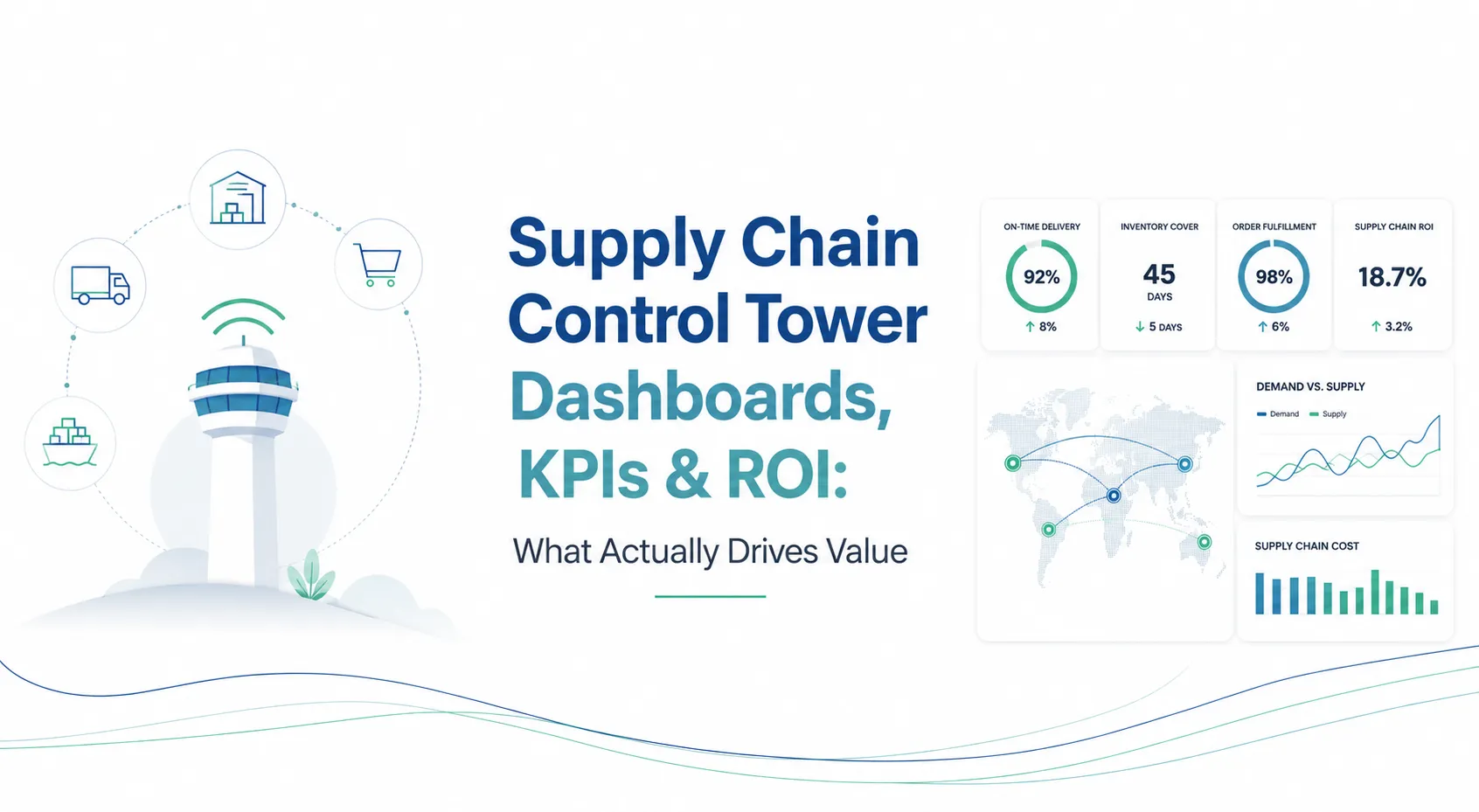
Every supply chain team has dashboards. Most of them cannot tell you whether the control tower is actually working.
There is a question most supply chain leaders avoid asking out loud.
If I turned off the control tower tomorrow would the operation actually get worse?
For a surprising number of enterprises, the honest answer is: not much. Because what they have built is not a control tower. It is a dashboard. A sophisticated, expensive, beautifully designed dashboard that shows what happened, where it happened, and approximately when someone noticed.
But decisions? Still made by humans. Exceptions? Still managed by email. Root causes? Still discovered in the weekly review meeting, five days after the problem compounded.
The technology exists to do far more. The problem is that most organizations have optimized for visibility metrics dashboard adoption, alert volume, user logins rather than the operational and financial outcomes that justify the investment.
This piece is about making that distinction clearly. What the right KPIs look like. Why most dashboards measure the wrong things. And what ROI from a control tower actually means when it is working.
The Dashboard Is Not the Control Tower
This is the distinction that most vendor conversations quietly avoid.
A dashboard aggregates data and presents it visually. A control tower senses, decides, and acts. The difference is not cosmetic. It is the difference between a scoreboard and a coach.
Walk into most enterprise operations centers today. There are screens. Multiple screens. Shipment status, inventory levels, supplier scorecards, exception queues, KPI dials cycling between green, amber, and red. It looks impressive. It feels like control.
But ask a harder question: what happens when something turns red? A planner looks at the alert. Opens another system to investigate. Sends an email to the carrier. Waits for a response. Updates the spreadsheet. Escalates to the manager. Schedules a call.
The dashboard is not the problem. Data aggregation is genuinely useful. The problem is mistaking the dashboard for the outcome and then measuring the control tower by how many screens are populated rather than how fast exceptions are resolved.
This is where KPI strategy either succeeds or fails. Organizations that measure dashboard adoption will get more dashboard usage. Organizations that measure exception resolution time, OTIF improvement, and freight cost per unit will get supply chain performance.
The KPIs That Actually Tell You Whether It Is Working
Most control tower KPI frameworks contain too many metrics and measure too few outcomes. The instinct to track everything is understandable; the data is there, the dashboards can display it, the teams are under pressure to demonstrate coverage.
But operational teams that track everything own nothing. Every KPI needs a clear owner, a clear decision it informs, and a clear action that follows when it moves in the wrong direction. Without that, a KPI is not a metric. It is a number on a screen.
Below are the eight that consistently separate control towers that drive value from those that generate reports:
KPI | What It Measures | Why It Matters |
|---|---|---|
OTIF Rate | Orders delivered on time and in full | The single number that tells you whether the supply chain is keeping its promises to the customer — or not. |
Perfect Order Rate | Orders fulfilled without error, damage, or delay | A composite signal. If this is high, most of the downstream problems take care of themselves. |
Cash-to-Cash Cycle Time | Days between paying suppliers and collecting from customers | This is working capital trapped inside the supply chain. Compressing it releases cash without touching revenue. |
Freight Cost per Unit | Total logistics spend divided by units moved | Separates efficiency from volume. A team that ships more is not necessarily a team that ships smarter. |
Forecast Accuracy | Variance between planned and actual demand | Bad forecasts are the upstream cause of most downstream firefighting. Fix this and exceptions become manageable |
Exception Resolution Time | Time from alert to corrective action | This is where most control towers fail. Fast detection with slow response is just expensive visibility. |
Inventory Days on Hand | Average days of inventory relative to consumption | Too high means cash tied up and obsolescence risk. Too low means stockouts and expedite costs. Both are expensive. |
Supplier On-Time Delivery | % of supplier commitments fulfilled on schedule | Your supply chain is only as reliable as your weakest supplier. This metric makes that visible before it becomes painful. |
A note on what is missing from this list. Absent are metrics like “shipments tracked”, “alerts generated”, and “dashboard logins”. These are activity metrics. They measure whether the technology is being used. They say nothing about whether it is delivering value.
Activity and outcome are not the same thing. Optimizing for one while calling it the other is how control tower programs stall.
Why Most Dashboards Measure the Wrong Things
There is a pattern that appears consistently in control tower implementations that underperform. It follows a predictable sequence.
First, the organization deploys the platform. Data from ERP, TMS, and WMS begins flowing in. Dashboards are configured. Teams are trained. Adoption targets are set. A success metric emerges: percentage of shipments tracked, number of active users, completeness of data coverage.
These are implementation metrics. They measure whether the system is running. They do not measure whether the system is working.
The distinction matters because the two diverge immediately. A system can have 100% shipment tracking coverage and still be losing money on premium freight because no one acted on the delay alerts fast enough. A system can have high dashboard adoption and still have OTIF declining because the alerts are drowning in volume and no one can separate signal from noise.
The KPIs that actually drive behaviour are the ones connected to financial consequences. Not “alerts generated” but “exceptions resolved before customer impact.” Not “shipments tracked” but “premium freight avoided.” Not “data completeness” but “cash-to-cash cycle time.”
The moment an organization connects supply chain metrics to P&L language, the conversations change. Procurement teams suddenly care about forecast accuracy because they understand what bad forecasts cost in emergency purchase premiums. Logistics teams engage with OTIF because they understand what a 1% improvement means in customer retention and contract renewals.
Metrics without financial translation are decorations. Metrics connected to consequences drive decisions.
What ROI From a Control Tower Actually Looks Like
The ROI conversation around control towers is frequently made harder than it needs to be. Organizations build elaborate business cases with dozens of assumptions. Implementation partners produce financial models that are impossible to validate after go-live. Boards approve the investment. Eighteen months later, nobody can agree on whether it worked.
This happens because the ROI framework was never anchored to the operational KPIs that actually move with the deployment. When the metrics are right, ROI becomes a straightforward calculation. When they are wrong, it becomes a debate.
Here is what the evidence actually shows, across structured control tower deployments:
Value Driver | Benchmark Range | What Actually Happens |
|---|---|---|
Premium freight reduction | 10–15% cost reduction | Catching disruptions early eliminates the need for expensive emergency shipping. |
Logistics cost reduction | 3–5% of total logistics spend | Accenture: enterprises that fully deploy control towers consistently deliver this range. |
Planner productivity | 30–40% improvement | Automating exception triage frees planners from firefighting and into decision-making |
OTIF improvement | 10–20% uplift | Faster exception resolution means more orders arrive complete and on time. |
ROI payback period | Under 12 months | Deloitte benchmark: 212% ROI achieved in less than one year on structured deployments. |
Root cause identification | Weeks → minutes | Deloitte case study: time to identify cost improvement opportunities cut from 2–3 weeks to ~5 minute |
The pattern across all of these is the same. ROI from a control tower does not come from seeing more. It comes from acting faster. Every value driver in the table above is a function of decision speed catching a disruption before it becomes a premium freight event, resolving a supplier delay before it becomes a production stoppage, identifying a forecast variance before it becomes excess inventory.
The Deloitte benchmark deserves particular attention: 212% ROI in under twelve months, with root cause identification time cut from two to three weeks to approximately five minutes. That is not a visibility improvement. That is a decision latency improvement. And decision latency is what the CFO should be measuring.
The Signal That Separates Value from Overhead
There is one metric that functions as a reliable indicator of whether a control tower is generating real value or simply generating reports. It is not on most standard dashboards.
Exception resolution time.
Specifically: the time between when an exception is detected by the system and when corrective action is taken. Not when it is logged. Not when it is escalated. When it is resolved.
This single metric captures everything relevant about whether the control tower is functioning as an orchestration layer or as a monitoring layer. An orchestration layer closes the loop between detection and action. A monitoring layer detects the problem and waits for a human to close it.
The path from monitoring to orchestration follows the same progression described elsewhere. Visibility earns the right to recommend. Recommendation earns the right to assisted execution. Assisted execution earns the right to autonomous action within governed guardrails.
At each stage, exception resolution time should be declining. If it is not if the control tower has been running for twelve months and exception resolution time has not moved that is the signal. The organization has invested in visibility infrastructure and stopped at the dashboard.
The fix is not more data. It is not more screens. It is not a larger exception queue.
It is governance clarity: defining precisely which exceptions the system is permitted to resolve autonomously, building the decision rules that allow it to act, and then measuring whether it does.
Building the ROI Framework Before Deployment
The organizations that achieve measurable ROI from control tower investments have one thing in common that most others do not. They define the ROI framework before deployment, not after.
This sounds obvious. It almost never happens. Typically, the business case is built to secure funding. Once the budget is approved, the conversation moves to implementation. By the time the system is live, no one is quite sure which metrics were supposed to move and by how much.
A structured approach looks different. Before a single line of integration code is written, three questions should have clear answers:
What are the three to five operational KPIs this deployment is expected to move?
These should be specific, measurable, and connected to financial outcomes.
What is the current baseline for each of those KPIs?
Without a baseline, improvement cannot be measured. Without measurement, ROI cannot be demonstrated.
What is the decision that each KPI informs and who owns it?
A KPI with no owner and no connected decision is a data point, not a performance metric.
Because clarity forces the right conversations early. Which exceptions should the system resolve autonomously? Which require human approval? What data quality is required before the system can make reliable recommendations? Who is accountable when the KPIs do not move?
These questions are uncomfortable to ask before go-live. They are far more expensive to leave unanswered until after.
Final Thought
Every supply chain team has dashboards. That is no longer a differentiator.
The differentiator is whether those dashboards are connected to decisions and whether those decisions are happening fast enough to prevent the downstream costs that control towers are supposed to eliminate.
The KPIs that matter are not the ones that measure whether the technology is running. They are the ones that measure whether the operation is improving. Exception resolution time. OTIF. Freight cost per unit. Cash-to-cash cycle time. These are the numbers that tell the real story.
And the ROI conversation becomes straightforward the moment the organization connects those operational numbers to P&L consequences. Because supply chain performance at its core is a financial outcome. Not a technology outcome.
Share this article