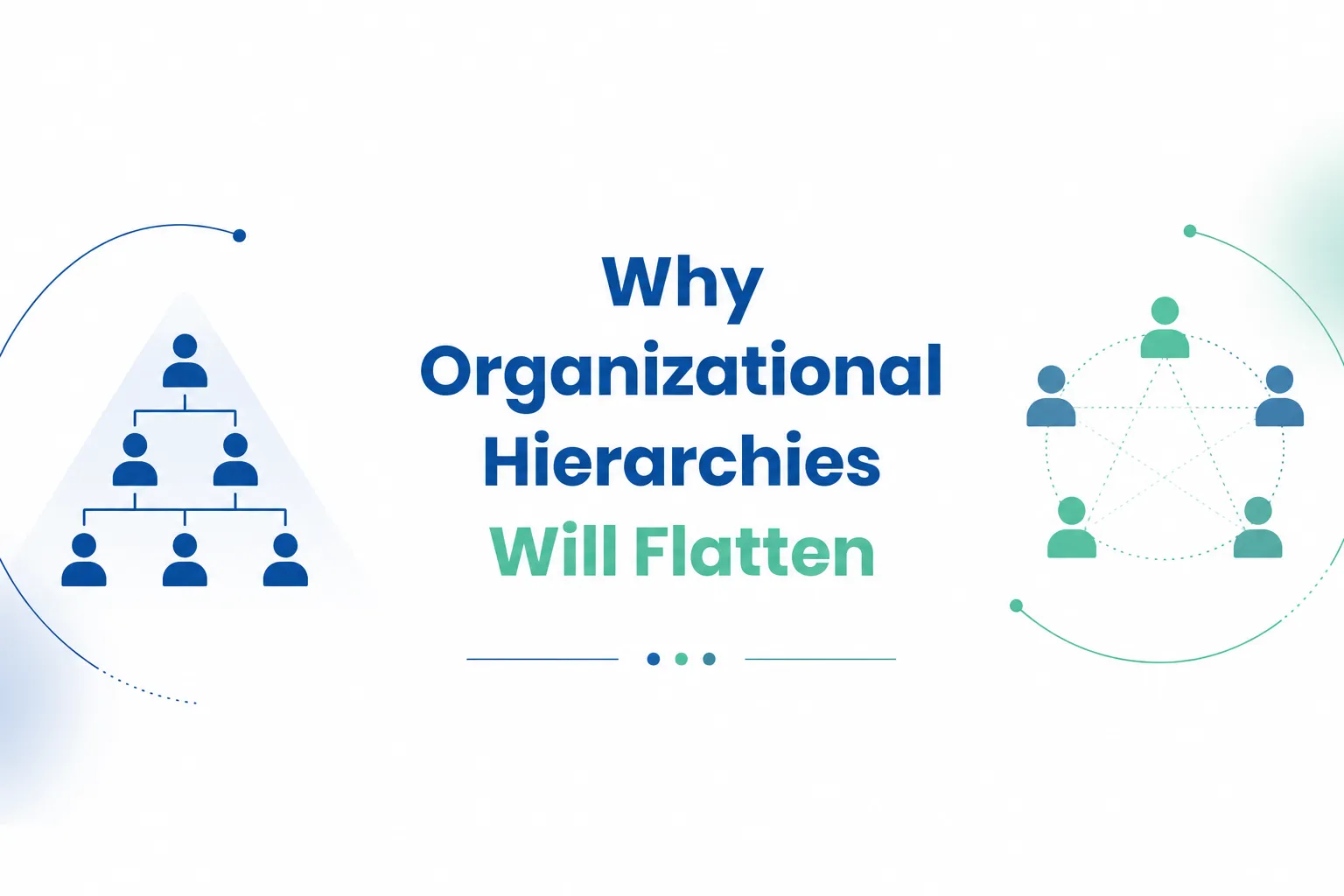
For more than a century, the modern enterprise has been built around hierarchy.
Leaders set direction. Managers translate direction into priorities. Frontline teams execute. Information moves upward. Decisions move downward. Approvals move across layers. Escalations move through chains of command.
This became so normal that we stopped asking why it existed in the first place. We assumed hierarchy was simply how large organizations had to operate.
But hierarchy was never the perfect design. It was the cheapest available answer to an expensive problem: coordination.
When information moved slowly, organizations needed layers to collect it. When decisions required human interpretation, they needed managers to process them. When execution had to be monitored manually, they needed supervisors to track it. When exceptions couldn't be classified intelligently, they needed escalation paths to decide who should step in.
Hierarchy, in other words, was never only a structure of authority. It was a structure of coordination.
That distinction matters, because AI changes the economics of coordination.
As enterprises move toward AI-workforce augmented operating models, work that once required layers of management can increasingly be handled by intelligent systems, AI agents, and policy-driven orchestration platforms. Work gets monitored continuously. Exceptions get classified automatically. Decisions get recommended in real time. Routine actions execute within defined guardrails. Leaders get pulled in when judgment is required, not whenever coordination is needed.
This doesn't mean enterprises become flat, chaotic, or leaderless. Quite the opposite.
The autonomous enterprise will still need leaders. It will still need accountability, governance, strategy, culture, ethics, and human judgment.
But it will need fewer layers whose only job is moving information, chasing approvals, coordinating handoffs, and managing routine execution.
That one idea may reshape how enterprises are designed.
The Original Purpose of Hierarchy
To understand why hierarchies may flatten, we first need to understand why they grew so large.
Hierarchy served five essential purposes.
It organized accountability.
As companies scaled, leaders needed to know who owned which function, region, plant, warehouse, customer segment, or business unit. Reporting structures divided responsibility into manageable units.
It managed information flow
Frontline teams understood operational reality, but senior leaders needed it summarized. Managers became the filters, interpreters, and translators of operational signals.
It controlled decision rights
Not every employee could approve every action, so organizations built layers to determine who could authorize spending, reprioritize work, change plans, negotiate trade-offs, or escalate risk.
It coordinated execution
In a large company, work rarely stays in one team. Planning affects procurement. Procurement affects manufacturing. Manufacturing affects warehousing. Warehousing affects transportation. Transportation affects customer commitments. Managers existed to align these moving parts.
It created stability
In slower, more predictable environments, hierarchy helped enterprises standardize work, reduce ambiguity, and maintain discipline.
This design was rational. It let large organizations scale beyond what informal coordination could manage. But every organizational solution eventually becomes a constraint when the environment changes.
Today's enterprise environment has changed dramatically. Supply chains are more volatile. Customers expect faster responses. Demand shifts more frequently. Products have shorter life cycles. Global disruptions travel faster. Data volumes have exploded. Decisions involve more variables. The speed of business has increased.
Yet many enterprises still run on structures built for a slower world. That is why hierarchy increasingly creates friction.
The Hidden Cost of Layers
Hierarchy creates order. It also creates latency.
Every layer adds interpretation. Every approval adds delay. Every escalation adds distance from the original signal. Every reporting chain risks losing context — softened, filtered, or politicized along the way.
A frontline planner sees a risk. The planning manager reviews it. The supply chain head asks for more analysis. Procurement gets looped in. Manufacturing validates capacity. Finance wants margin impact. Sales wants customer priority. Leadership asks for options.
By the time the enterprise reaches a decision, the original situation may have already changed.
This isn't because people are inefficient. It's because the operating model depends on human coordination across layers.
That sentiment captures the core issue. Hierarchy often turns operational signals into organizational journeys.
A demand shift becomes a meeting. A supplier delay becomes an escalation. A shipment exception becomes a cross-functional review. A planning conflict becomes a leadership decision.
In many enterprises, the cost of hierarchy never shows up on the balance sheet — but it shows up everywhere in execution.
It shows up as delayed decisions. Slow response to disruptions. Duplicated analysis. Too many meetings. Managers spending more time coordinating work than improving it. Frontline frustration. Customer promises missed because the organization took too long to align.
The issue isn't that hierarchy is bad. The issue is that hierarchy becomes expensive when it's used to solve problems intelligent systems can increasingly solve faster.
The Enterprise Hierarchy Was Designed for a World Where Information Moved Slowly
For most of enterprise history, information was scarce, delayed, and fragmented.
A plant manager knew what was happening inside the plant, corporate found out later. A warehouse supervisor knew dispatches were delayed, customer service found out later still. A transportation planner knew a lane was constrained, sales kept committing deliveries anyway. A supplier risk might be visible to procurement long before production planning felt the impact.
Because information moved slowly, organizations built structures to move it: daily reviews, weekly meetings, monthly operating reviews, escalation calls, status reports, management dashboards, executive summaries.
These mechanisms existed because the enterprise had no other way to create shared awareness.
The AI-native enterprise changes that equation.
Operational signals can now be captured continuously from ERP, TMS, WMS, IoT, emails, spreadsheets, external market signals, weather, supplier updates, and customer systems. AI agents can interpret these signals, detect anomalies, classify risk, model trade-offs, and recommend actions long before a human reporting chain would normally converge.
The enterprise no longer has to wait for information to climb the hierarchy. The operating system can surface the right information to the right person at the right time.
This changes the role of hierarchy itself. It no longer needs to exist primarily as an information transmission system. It can become a governance system.
That is a very different enterprise.
AI Will Not Eliminate Leadership. It Will Eliminate Unnecessary Coordination Layers.
There's a common fear that AI-driven organizations will remove managers. That's the wrong way to think about the shift.
AI does not eliminate leadership. It eliminates unnecessary coordination work.
Leadership involves direction, values, priorities, judgment, culture, talent, accountability, and long-term choices. These remain deeply human responsibilities.
Coordination is different. It includes collecting status updates, routing information, checking whether tasks are complete, classifying exceptions, following up on approvals, reconciling reports, scheduling reviews, and aligning functions around routine decisions.
A large portion of middle management effort today sits in this coordination layer.
As AI-workforce platforms mature, enterprises can move routine coordination from human hierarchy into intelligent orchestration.
The result is not a managerless company. The result is a less layered company one where managers spend less time moving work through the system and more time improving the system itself.
That is the real management shift.
From Human Coordination to AI-Workforce Augmentation
An AI-workforce augmented organization isn't simply about giving employees a chatbot or bolting copilots onto existing workflows.
It's about introducing a new type of digital colleague into the operating model.
These AI workforce agents monitor signals, analyze patterns, recommend decisions, execute approved actions, and continuously learn from outcomes. They don't replace the human workforce, they augment it, absorbing the coordination, analysis, and execution support that used to consume enormous organizational bandwidth.
Consider a supply chain organization.
Today, a planning team relies on managers to coordinate across demand, production, procurement, inventory, and logistics. Every exception triggers meetings, follow-ups, and approvals.
In an AI-workforce augmented model, a demand analyst agent detects a deviation. An inventory strategist agent evaluates stock exposure. A capacity planner agent checks production feasibility. A dispatch planner agent assesses logistics constraints. A scenario planner agent evaluates trade-offs. A resilience controller flags potential service risks. The system recommends the best action and escalates only what requires human judgment.
The human organization stays accountable. The AI workforce absorbs the coordination burden.
This is why hierarchy begins to flatten.
The enterprise no longer needs every routine decision to pass through multiple human layers. It needs leaders to define objectives, policies, constraints, and exception thresholds, while the AI workforce coordinates within those guardrails.
That is a fundamentally different organizational model.
What the Old Enterprise Looked Like
The traditional enterprise hierarchy was built as a pyramid.
Frontline teams executed tasks at the bottom. Supervisors ensured discipline and resolved immediate issues. Managers coordinated work across teams. Functional heads reviewed performance and approved trade-offs. Business leaders managed cross-functional priorities. Executives sat at the top, setting direction and resolving the biggest conflicts.
This worked reasonably well when business conditions were stable, data volumes were manageable, and decisions could wait for review cycles.
But as complexity increased, organizations kept adding layers, more coordinators, more process owners, more review forums, more regional heads, more functional leaders, more project management offices, more transformation offices, more control towers.
The enterprise became more layered because complexity grew faster than the organization could simplify itself.
That is exactly the trap many enterprises fall into.
Layers often become shock absorbers for complexity. They don't always remove it.
AI-workforce orchestration offers a different path. Instead of adding more human layers to manage complexity, enterprises can use intelligent systems to reduce the coordination load itself.
What the New Enterprise Might Look Like
The future enterprise won't be a flat network with no structure. Large organizations will still need clear accountability, business ownership, legal responsibility, and leadership.
But the structure may become far more compressed — a three-layer operating model instead of long chains of coordination.
The human frontline is supported by AI workforce agents that help teams execute faster and with better context. These employees aren't simply users of software — they're operators working alongside digital colleagues.
The policy and governance layer is where managers and functional leaders define operating guardrails, performance objectives, exception thresholds, trade-off logic, and escalation principles. Their role shifts from approving every action to designing the rules by which the enterprise acts.
The strategic leadership layer is where executives focus on direction, market choices, capital allocation, risk posture, culture, innovation, and enterprise transformation.
Between these layers sits the AI orchestration fabric — continuously connecting signals, decisions, and actions across the enterprise. It monitors operations, identifies exceptions, recommends actions, executes approved decisions, and learns from results.
The organization is still structured. It's just no longer dependent on hierarchy for every movement of information and every routine decision.
This is what flatter really means. Not less leadership. Less organizational drag.
Why Middle Management Will Change Most
The role most affected by this shift is middle management.
Middle managers have historically carried the burden of translation. They translate strategy into execution. Frontline signals into reports. Functional priorities into operational actions. Exceptions into escalations. Performance into review decks.
In many companies, middle managers are the human middleware of the enterprise.
AI-workforce augmentation changes that.
When systems can collect information, summarize context, classify exceptions, recommend actions, and coordinate workflows, the manager's role has to evolve.
The future middle manager becomes less of a coordinator and more of a system designer. They define operating principles. They shape decision policies. They train the AI workforce through feedback. They handle the exceptions that require judgment. They coach people. They build organizational capability. They make sure automation stays aligned with strategy, ethics, and customer priorities.
This is not a demotion of management. It is an elevation of management.
The manager stops being the person who keeps the machine moving and becomes the person who improves how the machine works.
The Approval Chain Will Shrink
One of the clearest signs of a hierarchical enterprise is the approval chain.
Approvals exist because organizations need control. But many approval chains exist simply because systems lack context.
A manager approves because someone must judge whether an action is reasonable. A director approves because the trade-off might touch multiple functions. A vice president approves because the financial impact crosses a threshold. A committee approves because no single team owns the full outcome.
In an AI-native enterprise, many approval chains can be replaced by policy-based decisioning.
This changes the role of approval.
Approval becomes exception-based rather than routine.
Managers approve what requires judgment, not what simply requires permission.
That alone can remove enormous latency from the enterprise.
The Meeting Culture Will Change
Hierarchies don't only exist in org charts. They exist in calendars.
The modern enterprise runs on meetings because coordination requires conversation — daily stand-ups, weekly reviews, monthly business reviews, escalation calls, alignment meetings, steering committees, war rooms.
Many of these meetings exist because the organization lacks a real-time shared operating system.
People meet to exchange updates. People meet to reconcile data. People meet to interpret dashboards. People meet to decide what the system should already know.
In an AI-workforce augmented enterprise, many meetings won't disappear — but their purpose will change.
Meetings become less about status and more about judgment. Less about what happened, more about what we should change. Less about who is following up, more about whether our policies are still right. Less about what the data says, more about what trade-off we're willing to make.
This is an important cultural shift.
A flatter enterprise isn't one with no meetings. It's one where meetings are used for human judgment rather than mechanical coordination.
The Distance Between Leadership and Reality Will Shrink
One risk of hierarchy is that leaders drift from ground truth.
Information travels upward through layers. Each layer summarizes, filters, edits, interprets, and sometimes protects itself. By the time a signal reaches the top, it may no longer resemble the reality experienced at the frontline.
AI can close that distance, not by overwhelming leaders with raw data, but by surfacing the right exceptions with context, explanation, and recommended actions.
A CEO doesn't need to know about every truck delay. But the CEO needs to know if a recurring logistics pattern is hurting strategic customers, damaging margins, or exposing a systemic network weakness.
A COO doesn't need to review every production deviation. But the COO needs to know if the system keeps overriding plans because capacity assumptions are unrealistic.
A supply chain leader doesn't need to read every dashboard. But they should know which decisions require a policy change.
In a flatter enterprise, leaders stay closer to reality because they're no longer dependent only on human reporting chains.
The enterprise operating system becomes a direct intelligence layer between reality and leadership.
Flatter Does Not Mean Weaker Control
Some leaders worry that flattening hierarchy means losing control. That's understandable.
For decades, control has been associated with approval layers. More approvals meant more discipline. More reviews meant more oversight. More managers meant more accountability.
But layers don't always create better control. Sometimes they create the appearance of control while slowing down action.
AI-native systems let enterprises rethink control.
Control can move from manual approval to embedded policy.
Instead of asking managers to review every decision, the enterprise defines rules, constraints, thresholds, and guardrails. The system acts within them, records decisions, explains recommendations, monitors outcomes, and escalates exceptions.
This creates stronger control, not weaker control, because every decision is traceable, every exception is visible, every policy can be tested, and every outcome becomes feedback.
This is governance by design, not governance by meeting.
That is the control model of the AI-workforce augmented enterprise.
The New Organizational Principle
The old organizational principle was: divide work into functions, assign responsibility, and escalate decisions upward.
The new organizational principle is: define outcomes, encode policies, augment teams with AI workforce agents, and escalate only what requires human judgment.
This sounds simple. It changes almost everything.
It changes how roles are designed. How managers are measured. How meetings are run. How approvals work. How functions collaborate. How leaders govern. How organizations scale.
In the old model, scale often required more layers. In the new model, scale requires better orchestration.
That is a profound difference
A Future Scenario
Imagine a large OEM operating across multiple plants, suppliers, warehouses, transport partners, and dealer networks.
In the traditional model, a supplier delay triggers a chain reaction. Procurement identifies the issue. Planning assesses demand impact. Manufacturing reviews production feasibility. Logistics checks alternative movement options. Sales identifies priority customers. Finance evaluates cost exposure. Managers coordinate. Leaders approve. Execution begins hours or days later.
In the AI-workforce augmented model, the enterprise detects the delay as soon as it appears. The AI workforce evaluates affected components, open orders, production schedules, dealer commitments, inventory buffers, transport options, and customer priority. It simulates multiple responses, ranks them by enterprise impact, and executes the policy-compliant path automatically. Only one decision escalates to leadership — because it involves a strategic customer trade-off.
The hierarchy didn't disappear. The work just didn't need to climb it before the enterprise acted.
That is the future.
What Leaders Must Do Now
The flattening of hierarchy won't happen automatically. Technology can make it possible leadership has to make it real.
Enterprises will need to redesign decision rights: which decisions can be automated, which require approval, and which require human judgment. They'll need to convert experience into policies, define guardrails for AI workforce agents, and align incentives so managers don't protect layers that no longer create value. They'll need to train leaders to govern systems rather than simply supervise people. They'll need to build trust gradually, expanding autonomy as confidence grows.
Most importantly, they'll need to stop confusing hierarchy with accountability.
Accountability remains essential. It doesn't always require layers.
Sometimes it requires better visibility, better policies, better decision logs, better exception handling, and better learning.
That is where AI changes the model.
The Big Shift
The enterprise hierarchy was designed for a world where information moved slowly. AI creates a world where decisions move instantly.
The enterprise hierarchy was designed for a world where managers had to coordinate work manually. AI creates a world where intelligent systems coordinate continuously.
The enterprise hierarchy was designed for a world where control depended on approvals. AI creates a world where control gets embedded into policy.
The enterprise hierarchy was designed for a world where complexity required more layers. AI creates a world where complexity requires better orchestration.
That is why hierarchies will flatten. Not because leadership becomes less important — because leadership becomes more important.
When routine coordination disappears, leaders can finally spend more time on the work that actually requires leadership.
Final Thought
The autonomous enterprise will not be leaderless. It will be less layered.
It will not remove accountability. It will redesign how accountability works.
It will not eliminate managers. It will change what managers are for.
The organizations that understand this early will gain a significant advantage. They will move faster. Respond better. Reduce decision latency. Free managers from coordination overload. Let leaders focus on strategy, culture, innovation, customer outcomes, and enterprise evolution.
For the last century, hierarchy was the price enterprises paid for scale. In the next century, intelligent orchestration may become the way enterprises scale without adding layers.
That is the promise of the AI-workforce augmented organization.
A company where human leaders define direction, AI workforce agents coordinate execution, and the enterprise operates with fewer handoffs, fewer delays, and far less organizational drag.
Hierarchy exists because coordination is hard. AI makes coordination cheaper.
And when coordination becomes intelligent, hierarchy stops being the only way to create order.
Share this article