Supply chain disruptions are no longer exceptional events. Port strikes, extreme weather, geopolitical lane closures, and sudden supplier failures have become a regular feature of global logistics. The question for enterprise operations leaders is no longer whether disruptions will occur. The question is how quickly an organisation can detect, respond, and recover and whether that recovery happens in minutes or in days.
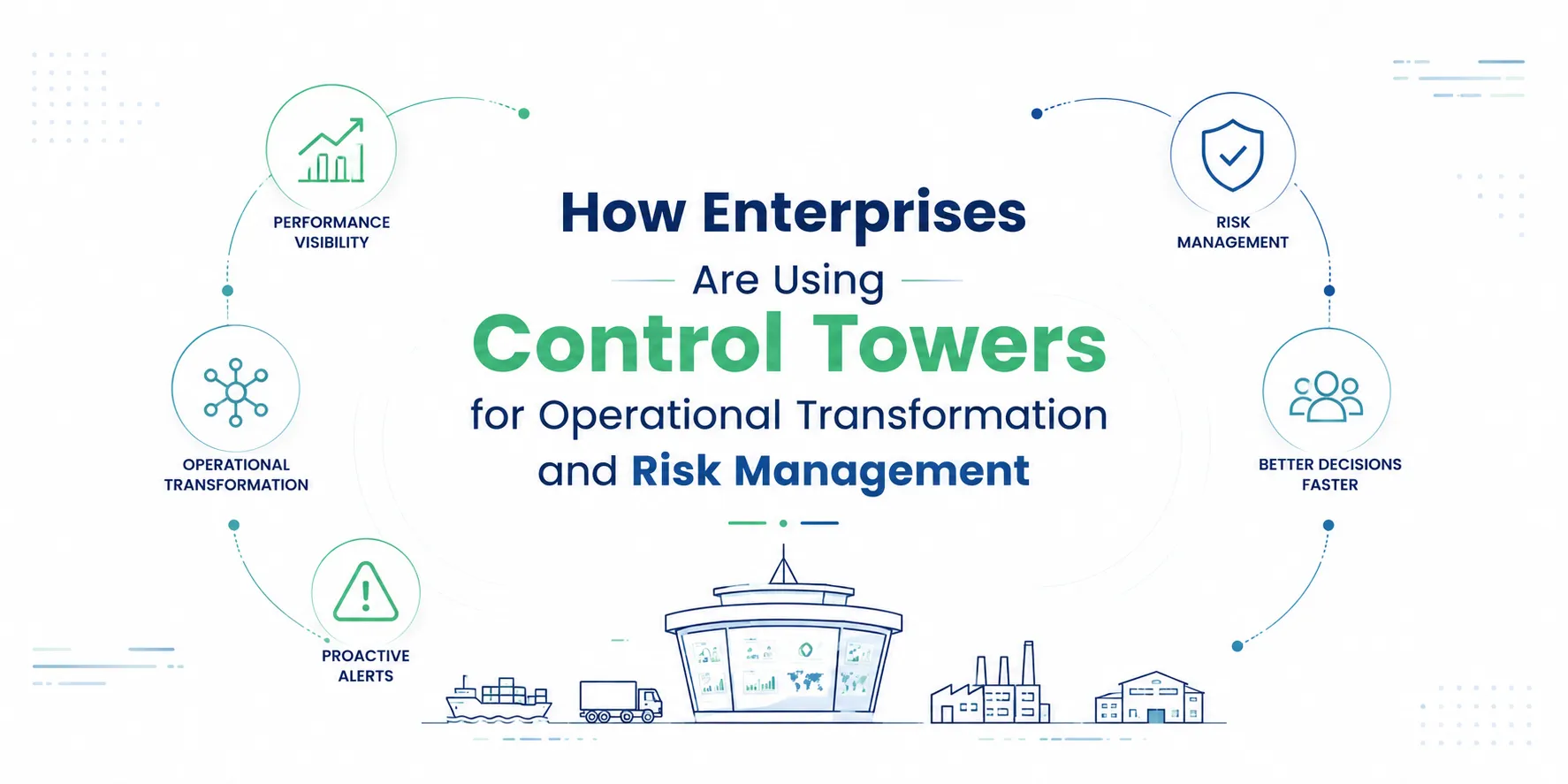
The enterprises pulling ahead on this challenge share a common characteristic. They have moved beyond visibility as a goal. They are using supply chain control towers for operational transformation deploying them not as reporting tools, but as platforms that detect risk earlier, respond faster, and increasingly act autonomously before a human has to intervene.
This article explains how that shift works, what it requires, and what measurable outcomes it produces.
Why Visibility Alone Does Not Solve Supply Chain Risk Management
The first generation of control towers was built on a compelling idea: real-time visibility across the logistics network enables better decisions. And compared to batch reports and manual tracking, that was genuinely true.
But enterprises that deployed these platforms quickly encountered a structural limitation. Visibility surfaces the problem. It does not resolve it. When a disruption alert fires, someone still has to investigate the cause, calculate the downstream impact, coordinate the response across carriers, warehouses, and commercial teams and execute the fix manually, across multiple systems, under time pressure.
The gap between seeing a problem and resolving it is precisely where competitive advantage is won or lost in supply chain operations. The platforms that are transforming enterprise operations have closed this gap by making decisioning and automated execution the core architecture, not an optional add-on.
Three generations of control tower capability where does your stack sit?
Generation one: centralised data into a unified dashboard. An improvement over spreadsheets, but the operating model remained reactive. Humans saw the alert and decided what to do.
Generation two: added planning capability. Demand forecasts and inventory positions connected to visibility data. Supply chain leaders could model how a disruption would ripple downstream. The response still required human coordination.
Generation three: closed the loop between intelligence and action. Disruption detected, downstream impact calculated, coordinated response triggered automatically. Routes adjusted, dock schedules updated, carriers and customers notified without waiting for a human to initiate each step. The human role shifts from reacting to overseeing.
Awareness alone does not change outcomes. Decisioning does. The shift from visibility to autonomous action is what separates resilient supply chains from reactive ones.
How Modern Control Towers Address Supply Chain Risk at Three Levels
Operational risk: preventing exceptions from becoming escalations
At the operational level, a control tower built for supply chain risk management predicts and resolves routine exceptions before they cascade. A delayed inbound shipment triggers automatic carrier contact, downstream schedule recalculation, and dock rescheduling not an email chain that works through the issue over two hours. The metric that reflects operational risk maturity is exception resolution time: the gap between disruption detection and confirmed corrective action. Enterprises with genuine control tower capability compress this from hours to minutes.
Tactical risk: modelling network-level disruption impact before it hits
At the tactical level, the platform provides scenario modelling that translates a logistics event into business impact which production lines will be affected, when the shortage will occur, what the customer impact will be with ranked response options and the cost of each. This shifts how supply chain leadership communicates with commercial and finance: from absorbing disruptions reactively to quantifying risk in advance and presenting structured options at the executive level.
Strategic risk: surfacing structural vulnerabilities before they become crises
At the strategic level, AI analysis of historical operational data reveals patterns invisible in day-to-day management. Specific lanes with chronic reliability problems. Suppliers with recurring delivery issues. Categories where demand volatility consistently outpaces safety stock design. This evidence base drives structural network decisions not just operational adjustments.
What Operational Transformation Looks Like in Practice
Successful control tower deployments consistently produce the same pattern of operational change across the first two to four quarters
Planner productivity transforms
Most logistics planners spend the majority of their time on exception management chasing carriers, manually rerouting delayed shipments, reconciling dock schedules. A control tower automating routine exceptions frees planners to focus on decisions requiring genuine human judgement. Planner-to-shipment ratios improve significantly, and the work shifts from reactive coordination to proactive network management.
Freight costs fall without service reduction
Better load planning, fewer spot market decisions, and automated freight audit all contribute to cost reduction. When shipment-level tracking connects directly to carrier invoices, overcharges, duplicate billing, and unverified accessorial fees are identified systematically eliminating the freight leakage that silently erodes margins in large logistics operations.
Customer service performance improves sustainably
When delivery windows can be predicted with documented accuracy and exceptions are managed before they miss commitments, customer-facing performance improves and stays improved. Proactive delay communication, delivered before a customer has to ask, is valued nearly as highly as on-time delivery itself in most B2B relationships.
The Organisational Change That Must Run Alongside the Technology
Technology rarely fails supply chain transformation programmes on its own. Organisational readiness does. The control tower changes the role of the logistics team, the expectations placed on carrier partners, and the relationship between supply chain, finance, and commercial leadership. Enterprises that treat implementation as a technology project skipping operating model redesign, KPI redefinition, and change management consistently underperform against those that treat it as a business transformation initiative.
Share this article