AI Use Cases: Explore Different Applications in Industries
AI’s Role in Business Operations
Artificial intelligence felt superficial and unrealistic when unexplored, but everything seems possible nowadays with its inception and implementation in bits and pieces. Automating mundane tasks, replacing humans in most time-consuming tasks, accurately analyzing large datasets, delivering personalized customer experience, helping with decision-making, and bringing innovation and creativity are a glimpse of AI.
According to a study by Vena, 80% of staff using AI reported a boost in productivity due to automation and less investment in time-consuming tasks. This significant growth helped businesses across industries generate sales and revenue rapidly. From manufacturing to healthcare and retail to financial services, enterprises utilize AI to streamline operations, drive innovations, and stay ahead of the competition.
Let’s understand the different cases of AI use in various industries.
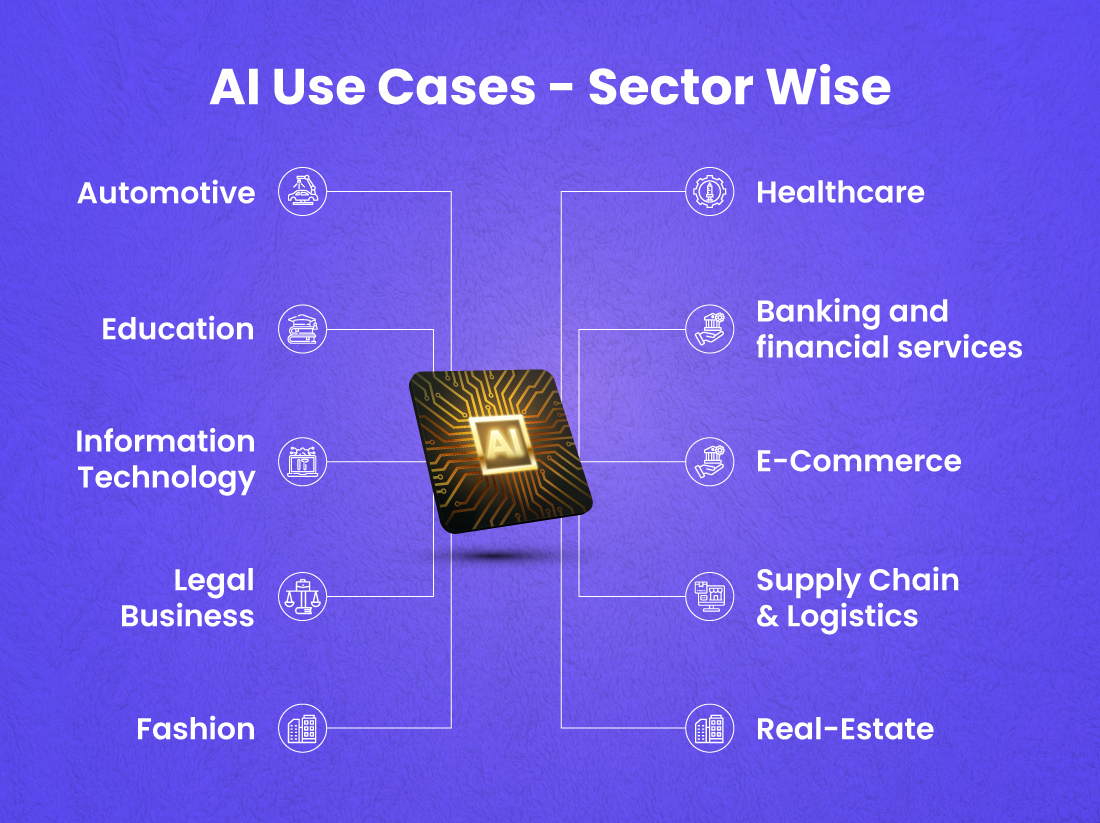
AI Use Cases - Sector Wise
AI’s adaptability across industries is prime evidence of how much potential the next-gen technologies have, and today, we are here to list down AI applications for business(s) that you run. Explore Artificial Intelligence use cases for your business.
Healthcare
AI use cases in healthcare enormously bring innovation, ensuring better and more accurate treatment of patients and helping healthcare professionals in the decision-making process.
Radiology : One of the most significant AI healthcare use cases is analyzing X-rays and CT scan reports on behalf of doctors and helping them make accurate decisions. With generative AI for healthcare, detecting lung nodules and identifying cancer growth and osteoporosis in X-rays becomes easy.
EHR Analysis : Another AI application for healthcare is EHR Analysis, which helps healthcare professionals extract patient data from unstructured formats. Besides, AI even offers real-time notifications about possible medicine interactions, typical side effects, and abnormal lab tests.
Remote Patient Care : AI-backed remote patient care demonstrates the potential of AI by offering healthcare services irrespective of location. It allows patients to sit back and relax at home while enabling healthcare professionals to still look after their patients. With AI, fostering proactive patient care becomes more accessible and possible.
Personalized Treatment : AI enables personalized treatment regimens by analyzing massive volumes of patient data; AI can identify specific risks, predict disease development, and offer individualized treatments. This data-driven strategy promotes more effective care, better patient outcomes, and lower healthcare costs.
Banking & Financial Services
Besides healthcare, AI contributes to banking and financial services with innovative possibilities and attention-worthy solutions.
Fraud Detection & Prevention : The first use case of AI in banking and financial services is helping avoid fraud by analyzing data and recognizing questionable patterns. AI systems detect irregular spending, fake accounts, and suspicious IP addresses. They constantly adapt to new fraud strategies, protecting customers while saving organizations time and money.
Credit Scoring & Risk Assessment : AI is transforming credit scoring by processing massive volumes of data. It uses alternative data to detect fraud, personalize lending conditions, and improve risk management. This leads to more accurate assessments, lower risk, and better financial outcomes for lenders and borrowers.
Anti-Money Laundering Compliance : Artificial intelligence is a significant tool for combating money laundering. It can analyze massive volumes of data to detect suspicious activity, automate customer due diligence, and assist firms in complying with AML requirements. Financial institutions can use real-time AML screening and monitoring software to improve their AML programs and lower the risk of money laundering.
Streamlined Regulatory Compliance : AI can automate data gathering, analyze hazards, and send real-time notifications to assure regulatory compliance. This helps firms save money, avoid penalties, and improve their compliance posture.
E-Commerce
There are ample AI use cases in eCommerce, out of which a few crucial ones are listed here, which you must ponder upon if you are into an ecommerce business.
Customized Shopping Experience : AI transforms retail by enabling tailored suggestions, predictive analytics, dynamic pricing, virtual try-ons, targeted marketing, and AI-powered customer service. This leads to more engaging shopping experiences and increased sales.
Customer Service : AI improves customer service by automating processes, offering individualized support, and obtaining insights. Chatbots, NLP, and predictive analytics are critical technologies. This increases satisfaction and loyalty.
Customer Churn Prediction : AI can examine consumer data to detect patterns that indicate churn risk. Businesses can address complaints and keep important ones by creating predictive models and segmenting customers.
Supply Chain & Logistics
AI use cases in logistics and supply chains transform several departments, such as warehouse operations, inventory management, and monitoring international packages and couriers. The case study demonstrates our command over AI integration and implementation in these areas.
Warehouse Optimization : AI optimizes warehouse operations by enhancing inventory management, demand forecasting, layout, automation, quality control, and predictive maintenance. This results in improved efficiency, lower costs, and higher customer satisfaction.
Inventory Management : AI improves inventory management by anticipating demand, optimizing levels, and increasing supply chain efficiency. It monitors real-time inventory, recognizes demand changes, and cuts expenses.
Supply Planning : AI is transforming supply chain management through valuable insights and automation. It can adequately estimate demand, optimize inventory, control risks, optimize transportation, and improve supplier relationships, increasing efficiency, lowering costs, and increasing customer happiness.
Real-Estate
Next on the list is the AI use case on real estate, which overcomes several challenges and offers multiple AI-backed solutions to real estate sector. So, here are real-estate AI use cases:
Property Management : AI transforms property management by automating chores, streamlining operations, and increasing tenant happiness. It anticipates maintenance needs, offers 24-hour support, automates rent collection, optimizes energy use and personalized marketing, and enhances security. Property managers can use AI to increase productivity, cut expenses, and improve the tenant experience.
Property Valuation : AI has significantly improved property valuation by analyzing vast datasets, creating predictive models, and using automated valuation models. This technology enhances accuracy, streamlines the process, and helps assess risks associated with properties.
Market and Investment Research : Artificial intelligence is revolutionizing market and investment research. By processing massive amounts of data, AI can identify patterns, forecast trends, optimize portfolios, and detect fraud. This allows investors to make more informed decisions and achieve more significant results.
Automotive
Many automotive companies have already adapted AI to overcome manufacturing challenges, optimize, assist, and perform other purposes. To give a detailed idea of how AI revolutionizes the automotive industry, we have listed down various AI use cases for the automotive industry.
Enhanced Navigation : AI-powered navigation systems provide real-time updates, traffic predictions, autonomous capabilities, optimal maritime routes, and indoor navigation, improving navigation efficiency and safety.
Vehicle Navigation : AI improves navigation systems by offering real-time traffic updates, predictive routing, self-driving capabilities, natural language understanding, and automated map updates.
Manufacturing Process Optimization : AI improves production by predicting equipment breakdowns, maintaining quality, managing supply chains, automating jobs, and increasing energy efficiency. This results in increased competitiveness, lower costs, and higher customer satisfaction.
Education
AI played a revolutionary role in COVID-19, bringing possibilities that were once just the talk of the town. With AI, students can now sit at home and complete their academics without delay or challenges. Tutors can focus on each student and solve their doubts over video sessions.
Personalized Learning : AI revolutionizes education by tailoring lessons to individual requirements, offering tailored guidance, and curating content. This results in more engaging and effective learning opportunities for all students.
Learning Analytics : AI can personalize learning, anticipate student success, and deliver adaptive learning experiences. It also analyzes data for patterns and provides intelligent tutoring. Using AI, instructors can increase student learning and outcomes.
Automated Grading : Grading jobs are being automated using AI, which is transforming education. It can quickly grade objective questions and deliver individualized feedback. While artificial intelligence does not entirely replace human judgment, it does help educators save time and maintain consistency.
Here is what we have built for our client, who wanted an automated grading feature through AI as one of their core requirements.
Information Technology
Information technology is a consistently evolving industry that brings innovations to life. You name it, and this sector delivers the product. Besides, AI use cases in IT operations ensure making a reality; you can go through one of our case studies on how AI helped image creation and editing and personalize them. Here are some AI applications for the IT industry:
Cybersecurity and Threat Detection AI is an effective tool for cybersecurity. It analyzes data, detects risks, sends alerts, forecasts assaults, automates tasks, and improves threat intelligence. This enables businesses to safeguard their data and systems against cyber assaults.
IT Asset Management : AI automates asset detection, failure prediction, cost optimization, compliance monitoring, and security risk assessment, enabling IT teams to manage assets efficiently and effectively.
Predictive Maintenance : AI analyzes sensor data to forecast equipment faults, allowing for prompt maintenance and avoiding unplanned downtimes. This lowers expenses and improves operational efficiency.
Fashion
Artificial intelligence (AI) is revolutionizing the fashion industry, from design to production and sale. Fashion firms can stay ahead of the curve by embracing AI-powered solutions to optimize processes, improve customer experiences, and innovate.
Fashion Trend Forecasting AI predicts forthcoming fashion trends by analyzing massive volumes of social media trends, sales data, and search engine inquiries. This allows firms to predict consumer preferences and tailor their product ranges accordingly.
Merchandising Analysis : AI improves merchandising by evaluating data to estimate demand, plan assortment, optimize price, customize recommendations, and manage inventory effectively.
Design & Product Development : AI transforms design and product development by producing new designs, improving material choices, simulating performance, personalizing products, and streamlining supply chains. This results in more inventive, efficient, and personalized products.
Legal Business
Artificial intelligence (AI) in the legal sector promises to automate tasks, increase efficiency, boost legal research, and offer predictive analytics. AI-powered solutions will assist lawyers and legal professionals in providing more effective and efficient services.
Contract Analysis : AI is changing contract analysis by automating activities, improving accuracy, and delivering important insights.AI-powered solutions can extract essential clauses, identify hazards, and speed up the review process, saving time and decreasing errors. This allows legal teams to focus on strategic responsibilities while providing more excellent client service.
Legal Research : Artificial intelligence transforms legal research by automating tasks, increasing efficiency, boosting accuracy, and giving predictive analytics. AI-powered technologies can analyze massive legal databases, identify relevant cases, extract essential information, and forecast case outcomes. This allows lawyers to do more thorough and efficient research, boosting the quality of legal services.
Legal Analytics : AI-powered contract analysis is transformative for legal teams. By extracting crucial information from contracts, AI assists in identifying opportunities, renegotiating terms, ensuring compliance, and planning for strategic projects. This improves productivity, reduces risks, and enables more informed decision-making.
Online Dispute Resolution : AI-powered ODR technologies simplify dispute resolution by automating chores, evaluating data, and recommending solutions. This lowers expenses, increases efficiency, and promotes fairness. As AI progresses, we can expect more inventive legal uses.
Due Diligence : AI transforms legal practice by automating processes, boosting research, and assessing risk. Lawyers can use AI-powered technologies to expedite workflows, make more competent judgments, and provide better client results.
These are the different AI use cases for every industry that provides exceptional customer services and benefits. Now, let’s see how the AI implementation process works.
AI Implementation Process
Several crucial steps are involved in implementing AI in any of the use cases you read above. Here are the steps to follow:
Identifying Business Objective
Let’s connect and identify which of your business areas urgently need AI, not only for automation but also for adding value to your customers and boosting revenue. This could include anything from offering impressive customer services to analyzing data, automating robotic processes, and ensuring the right decisions are made. Connect with an AI development company and find the correct department of your business to implement AI.
Business Objectives Evaluation
With meticulous business objective analysis, you can determine your business objectives and how AI can be helpful. Ensure the objective includes reducing costs, enhancing costs, bringing innovations, and winning a competitive edge.
Data Collection and Analysis
Next comes training the AI model, which requires extensive and quality datasets. Ensure you have accurate, labeled, precise data that helps AI models understand and act accordingly.
Picking AI Technologies
Now that you know your business objectives and how you want AI to help uplift your business, it’s time to select the appropriate AI technology, including machine learning, natural language processing, computer vision, neural networks, or a combination of every technology. We even advise our clients to select pre-built or easily customizable Artificial Intelligence solutions to suit their requirements.
Integrating AI into Existing Platforms
Next step in the process is to help you integrate AI into your existing business platform and workflows. Make sure the AI systems you integrate are equally compatible and secure, meaning check for software updates and maintenance.
Tracking Performance
It’s important to monitor AI models’ performance to achieve business objectives. You must ensure that the AI model’s performance aligns with your business objectives; if not, you must take corrective measures to maintain the performance.
Are you ready to leverage cutting-edge technology, streamline your logistics, and take full control of your supply chain?

.jpg)