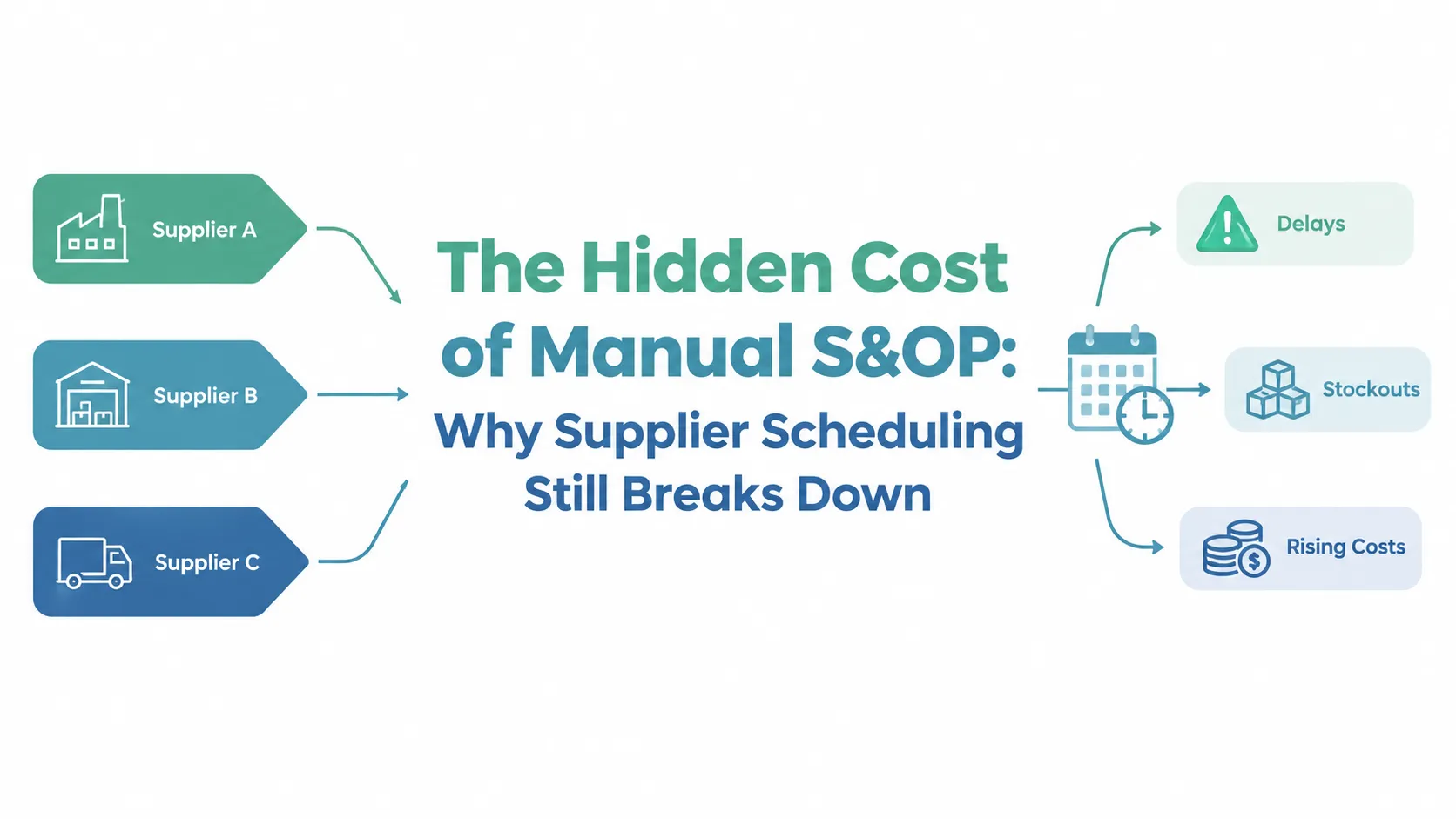
A supplier commits to the 10th. On the 8th, an email arrives: the material will now land on the 12th. Somebody updates a spreadsheet. Somebody else does not. Production keeps its original sequence, dispatch keeps its original promise, and by the time the gap surfaces in the weekly review, the plant is already absorbing the difference in expediting, idle time and reshuffled orders.
That scenario came up again and again in our conversations with manufacturers this year. It rarely makes headlines, yet it quietly shapes service levels, inventory and margins every week. The cause is seldom a single bad supplier. It is a sales and operations planning (S&OP) process that still runs on spreadsheets, disconnected from the supplier schedules it depends on.
This article unpacks where supplier scheduling breaks down inside manual S&OP, what it really costs, and how connected, AI-driven planning keeps supplier commitments, production and dispatch moving as one plan.
What Manual S&OP Looks Like in Practice
Most manufacturers have the right ingredients for S&OP: an ERP such as SAP or Oracle JD Edwards for MRP and purchasing, a statistical forecast, and a monthly consensus meeting. The challenge sits in the space between those systems. In call after call, teams described the same pattern:
• The ERP is the system of record, but the actual planning happens in Excel and is pushed back manually.
• Demand planning is reasonably mature, while supply, production and rough-cut capacity planning (RCCP) remain spreadsheet-driven.
• Supplier schedules arrive by email, phone or portal, and are reconciled by hand against the production plan.
• The S&OP cycle is monthly, while supplier reality changes daily.
This setup works when supply is stable. Supplier scheduling is where it is tested first, because it is the point where an internal plan meets an external partner with its own constraints, priorities and lead times.
Five Places Supplier Scheduling Breaks Down in Spreadsheet-Led S&OP
These five patterns were the most frequently discussed in recent discovery calls with manufacturers across automotive components, chemicals, consumer goods and industrial equipment.
1. Commit dates move, but the plan stays still
A supplier confirms a date, then revises it by two days. In a manual process, that change lives in an email thread. There is no structured way to capture it as an exception, measure its knock-on effect, or replan the production sequence. A short slip on one critical input can ripple into line changes, missed dispatch windows and revised customer commitments.
2. Every buyer keeps a private shortage sheet
One of the most candid observations we heard: each buyer maintains their own Excel file for shortages. Each file is accurate to its owner, yet the organisation has no single view of supply risk, no shared prioritisation and no audit trail of who chased what. Leadership sees the shortage only once it reaches the shop floor.
3. Long, variable lead times outrun the monthly cycle
Several manufacturers described supplier lead times of 45 to 60 days for key components, while customer and OEM schedules shift within weeks. A monthly S&OP cycle cannot absorb that variability by itself. Without lead-time-aware replenishment and scenario planning, teams either over-buffer to stay safe or run short when demand rises.
4. Suppliers cannot see what matters most
Supplier scheduling is a two-way problem. Many suppliers, co-packers and contract manufacturers struggle to prioritise work because they receive volumes without context. At the same time, the manufacturer often has limited visibility into the supplier's raw material, packaging or pipeline stock, and cannot extend its internal systems to supplier sites. Both sides plan with half the picture.
5. Plans stop at the ERP boundary
Even when a planner spots the right action, executing it means manually raising purchase orders or stock transfer orders in the ERP. Teams told us they need a sales and operations execution (S&OE) layer tightly linked to SAP so decisions turn into orders quickly. A related need is full-kit logic: moving 90 of 100 components while 10 are unavailable only creates blocked, non-moving inventory. Effective supplier scheduling plans the complete kit.
The Hidden Cost of Manual S&OP
The cost rarely appears as one line item. It is spread across working capital, freight, people and service, which is exactly why it stays hidden.
Working capital locked in safety buffers
When supplier timing is uncertain and invisible, the rational response is to hold more stock. Buffers rise across raw materials, work in progress and finished goods, and cash is tied up in inventory that exists to compensate for missing information rather than real demand variability.
Expediting and premium freight
Late discovery leaves only expensive options: air freight, dedicated vehicles, split shipments and overtime. Each one solves today's gap while adding cost that never makes it into the original plan.
Planner capacity spent reconciling
Hours go into merging spreadsheets, chasing confirmations and rebuilding plans by hand. That time could be spent on scenario analysis, supplier development or improving forecast quality, the work that actually raises planning maturity.
Customer commitments and trust
Every supplier slip that is caught late becomes a revised promise to a customer. Over time, on-time-in-full (OTIF) performance and customer confidence carry the cost of a planning process that could not respond in time.
What Connected Supplier Scheduling Looks Like
Connected supplier scheduling treats supplier commitments as live inputs to S&OP, not as a separate follow-up task. Five capabilities make the difference.
One shared supply picture
Supplier commitments, open purchase orders, in-transit material and on-hand stock come together in a single view at SKU, plant and supplier level. Everyone works from the same numbers, and shortages are visible against the products and customers they affect.
Scenario simulation before you commit
Supply scenario simulation models the effect of a supplier delay or lead-time change on production and dispatch before anyone acts. Planners can see how fulfilment recovers over the coming days under each option, such as waiting, re-sequencing production or switching to an alternate source.
Replenishment driven by BOM, lead time and rolling forecast
Order quantities and timing are calculated from the bill of materials, supplier lead times, turnaround times and the rolling forecast, with minimum order quantities respected at SKU level. Supplier schedules are generated from the plan rather than negotiated in isolation.
Exceptions handled as workflows
When a supplier revises a date, the change is captured as an exception and routed to the right owner with its impact attached. Resolution becomes traceable, and escalations follow defined rules instead of phone calls.
Consensus with controlled write-back to the ERP
Approved plans flow into SAP or other ERPs through a governed sign-off process, triggering purchase orders and stock transfers without manual re-keying. S&OP and S&OE finally operate on one rhythm.
Area | Manual S&OP | Connected S&OP |
|---|---|---|
Supplier date changes | Captured in emails and calls | Logged as exceptions with impact on production and dispatch |
Shortage tracking | Individual spreadsheets per buyer | One shared shortage view by product, customer and supplier |
Replanning cadence | Monthly, at the S&OP meeting | Continuous, triggered by each change |
Lead-time variability | Absorbed by extra buffer stock | Modelled through scenarios and dynamic safety stock |
Execution | POs and STOs raised manually in the ERP | Approved plans written back to the ERP through sign-off |
Kit completeness | Partial kits move and block stock | Full-kit logic plans complete component sets |
How Enmovil Brings Supplier Scheduling Into Sync
Enmovil is an AI-native supply chain and logistics intelligence platform. Its Supply Chain Planning suite connects demand, supply and execution so supplier schedules stay aligned with what the business actually needs to make and ship.
• Demand forecasting: SKU-by-location forecasts with automated model selection, external drivers and forecast-versus-actual tracking.
• Inventory and replenishment planning: dynamic safety stock, reorder points and order recommendations built from BOM, lead times and rolling forecasts, including vendor scheduling.
• Consensus S&OP: line-item consensus, assumption management and approval workflows, with baseline and scenario plans published separately.
• Supply scenario simulation: supplier-disruption and lead-time-variability scenarios that show the impact before decisions are locked.
• Intelligent production planning and RCCP: sequences production across lines considering demand, material availability and changeovers, and replans when supply shifts.
CADDIE, Enmovil's AI Workforce, orchestrates these workflows. Working inside Microsoft Teams and Outlook, CADDIE can fetch orders from the ERP, run planning algorithms, surface exceptions such as a supplier date change, and route decisions for approval within defined rules and thresholds. Planners stay in control of the decision, while the routine coordination runs in the background.
Enmovil works alongside existing ERPs rather than replacing them. Teams can start with a simple Excel upload of supplier and order data, integrate with SAP, Oracle or other ERPs through APIs as they scale, and adopt one module at a time.
Frequently Asked Questions
What is manual S&OP?
Why does supplier scheduling break down in manufacturing?
What is the difference between S&OP and S&OE?
How does AI improve supplier scheduling?
Do we need to replace our ERP to move beyond manual S&OP?
How quickly can a manufacturer move to connected S&OP?
Share this article