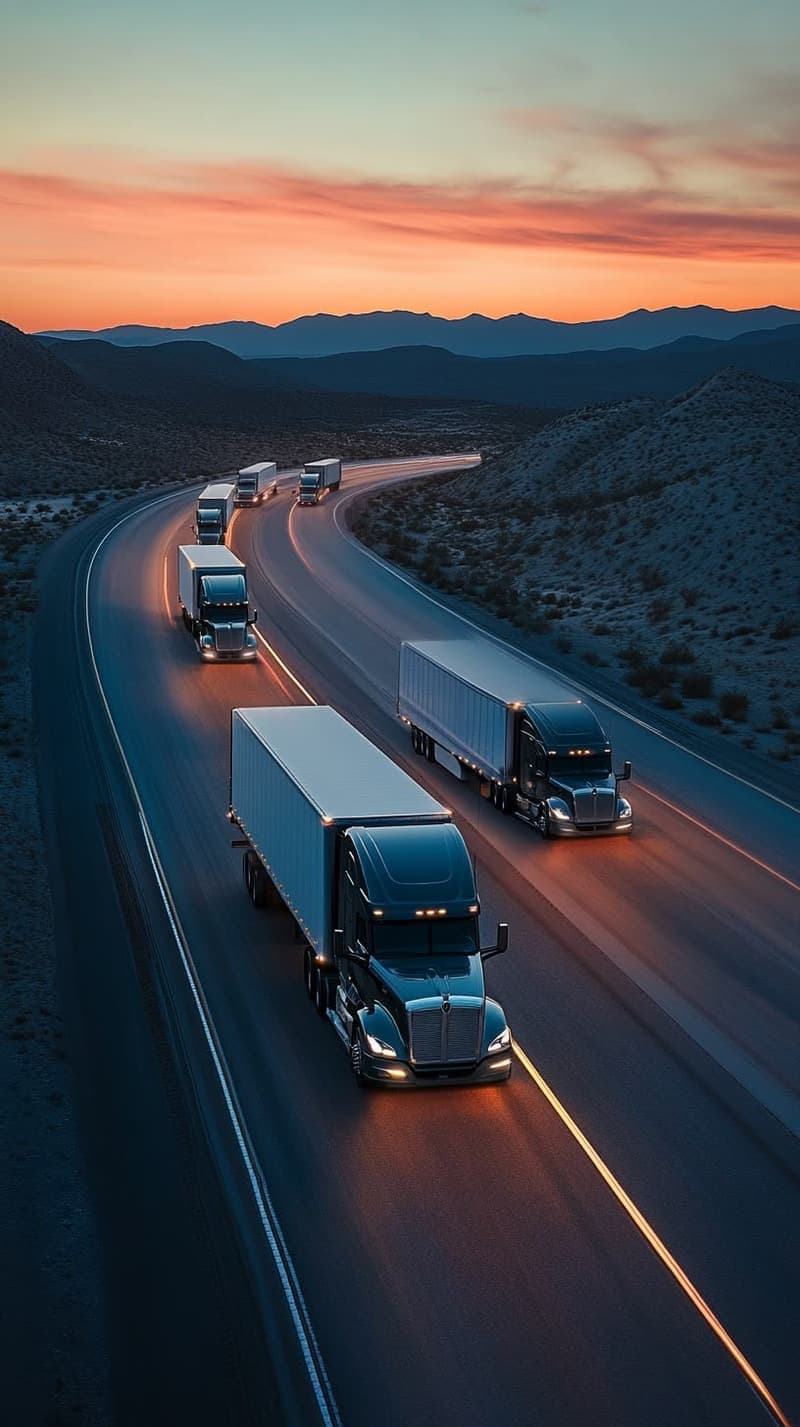
For decades, supply chain leaders lived by a rigid rule. You had to balance three things: cost, service, and speed. If you wanted faster deliveries, you paid more for trucks. If you wanted lower costs, you suffered longer transit times. Fixing one area always hurt the other two.
Today, that old rule is dead.
The US market in 2026 faces severe pressures — nearshoring shifts to Mexico and Canada, chronic truck driver shortages, extremely tight profit margins. You can no longer afford to trade service for cost. The rise of AI in supply chain operations changes the math completely.
From systems of record to systems of decision
Why do traditional logistics setups fail to scale? The answer lies in their core technology. Most large companies rely on legacy ERP platforms like SAP or Oracle. These older systems act as passive systems of record — they only capture data after a human makes a decision. A human plans the route, a human books the truck, the ERP records the final invoice. This forces your team to manage the workflow, not the actual work.
“We bring decision-making inside the system — optimising dispatch routes, replenishment, and forecasting — and then push the plan back into the ERP for execution.”
What changes with autonomous orchestration?
Manual planning → active intelligence
The system decides the best route and truck automatically — no human swivel-chair required.
Batch processing → real-time action
Freight tracked instantly, alerts trigger automatic playbooks, exceptions resolved before humans notice.
Siloed teams → unified command layer
Forecasting, execution, and billing operate as one connected engine — one plan, one truth.
1. Cost-to-serve optimisation — eliminating invisible leakage
When executives ask how AI reduces costs in supply chain management, they often think of simple route mapping. But the cost impact goes much deeper — it eliminates hidden money leaks across the entire network. Old cost models focus only on freight rates. AI-native systems look at the whole picture and optimise the system, not just the single transaction. Recent industry data shows AI-powered supply chains can reduce overall logistics costs by up to 15%.
A. Smart dispatch optimisation
OptiRun evaluates 50+ business rules at once, builds perfect 3D loads, and matches the right truck to the right dock — so you stop paying for empty miles.
B. Accurate inventory forecasting
OptiPred predicts demand spikes using historical data and market trends. Top manufacturers report 20%+ working capital freed from AI inventory optimisation.
C. Automated freight reconciliation
Autometrics checks every carrier bill against your rate card — catching overcharges and duplicate bills before you pay. 3–8% of freight spend recovered automatically.
2. Service levels — from reactive SLAs to predictive reliability
In the past, high service levels were very expensive to maintain. To make sure customers got their orders on time, companies built massive safety buffers — extra inventory at regional hubs, backup trucks booked just in case, peace of mind purchased at the expense of margin. This reactive model protects service but destroys profitability.
You no longer need expensive buffers when you have absolute trust in your data. An AI control tower gives you real-time visibility across road, rail, air, and ocean — and it does not just track trucks, it senses delays before they happen.
3. Speed — decision velocity as a competitive edge
Speed is no longer just about driving faster trucks. Speed is about making faster decisions. Modern enterprise logistics involve millions of complex planning choices every day. A human planner cannot check thousands of truck options, strict driver hours, and factory dock limits in five minutes. An AI engine can.
This is where we see the massive power of generative and agentic AI. With CADDIE, a logistics leader simply types a question into Microsoft Teams or WhatsApp and gets an executive-grade answer without pulling a single report.
“Caddie, which inbound shipments to the Texas plant face delays today, and what is the cost impact? — Three shipments are delayed due to border traffic. The cost impact is $4,500 in detention fees. I have already alerted the receiving dock to reschedule.”
The hidden cost of "swivel chair" integration
Many companies try to buy isolated AI tools. One AI tool to predict demand. A different tool to track trucks. Excel to audit freight bills. This creates the swivel-chair problem — your team manually swivels between screens to move data from one system to the next. It kills efficiency. A fragmented tech stack destroys the benefits of AI in supply chain management.
You must build a complete Supply Chain Intelligence Layer with a simple philosophy: Predict. Plan. Execute. This requires a closed-loop execution model. Enmovil provides the autonomous decision engine. To ensure flawless enterprise adoption, you need an ecosystem — which is why Enmovil partners with integration experts like SRM Tech.
The flywheel effect — why AI scales exponentially
What makes an AI-native supply chain economically superior? It compounds its own intelligence over time. Every decision the AI makes feeds back into the system. If a specific highway always causes a 30-minute delay on Tuesdays, the AI learns this rule. It improves future advice. It reduces daily exceptions.
This creates a powerful, self-reinforcing flywheel: better decisions lead to lower cost, which leads to higher service, which leads to faster execution, which produces even better decisions. Most enterprises still operate with disconnected planning tools and delayed reports. Enmovil replaces this broken model with end-to-end orchestration — a supply chain that runs like a high-performance operating system, not a messy collection of tools.
The strategic imperative for US enterprises
Four rules for winning the 2026 market
AI is infrastructure, not a tool
AI must sit at the core of planning and execution. It cannot just be an overlay on a broken process.
Cost leadership is algorithmic
Profit margins depend on decision intelligence. Scale alone is no longer enough to win.
Service must be predictive
Customer experience is defined by how well you anticipate problems — not how fast you react to failures.
Speed must be cognitive
The fastest supply chains will be those that think faster — not just the ones that move faster.
Frequently asked questions
What is the role of AI in supply chain and logistics?
How does AI reduce costs in supply chain management?
How is generative AI used in supply chains today?
What is an AI-native supply chain?
Share this article