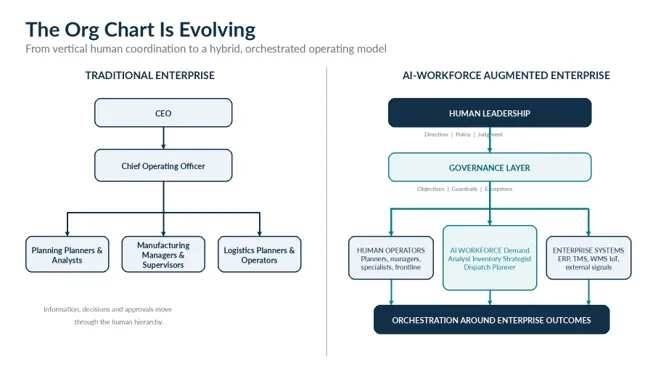
Open the organizational chart of almost any large enterprise and you will see a familiar structure. At the top sits the CEO. Below are business heads and functional leaders. Their organizations branch into Planning, Procurement, Manufacturing, Warehousing, Logistics, Finance, Sales and Customer Service. Each function has managers, specialists, analysts, coordinators and operating teams.
The chart tells us who reports to whom. It tells us where accountability sits. It tells us how the organization has divided responsibility.
But it is beginning to tell only half the story.
A new operating layer is emerging inside enterprises. It does not appear in employee directories. It does not occupy office space. It is not included in headcount planning, and its members do not receive salaries, promotions or annual performance reviews. Yet this layer is beginning to observe operations, analyse information, recommend actions, execute workflows, coordinate across functions and learn from outcomes.
For years, enterprises have spoken about artificial intelligence as a technology. AI was a feature added to an application, an analytical model, a chatbot or a productivity tool. Employees remained the operators. Software waited for someone to log in, enter information, interpret a dashboard and decide what to do.
That assumption is now changing. Software waited to be used. AI workers observe, reason, act and collaborate.
The next workforce transformation will therefore not be defined only by how employees use AI. It will be defined by how enterprises divide work between human employees and AI workers, how the two collaborate, and how leaders govern this new hybrid organization.
Your current org chart may accurately represent the people who work for the enterprise. It may not represent all the work being performed inside it.
When Software Stops Being a Tool and Starts Performing a Role
Traditional enterprise applications are tools. A transportation management system helps a planner create routes. A warehouse management system helps a supervisor manage inventory movement. An ERP system records transactions. A forecasting application helps a demand planner analyse historical patterns.
These systems may be extremely sophisticated, but their fundamental operating model is the same. A human initiates the work, interprets the information and remains responsible for moving the process forward.
An AI worker operates differently. It may continuously monitor demand signals without being asked. It may identify an emerging stockout risk, examine inventory across locations, assess production capacity, evaluate alternative supply and prepare a recommended response. It may then initiate approved actions or escalate the decision when the situation falls outside its authority.
The difference is not simply that the AI is more intelligent than previous software. The difference is that it has been assigned an operational role.
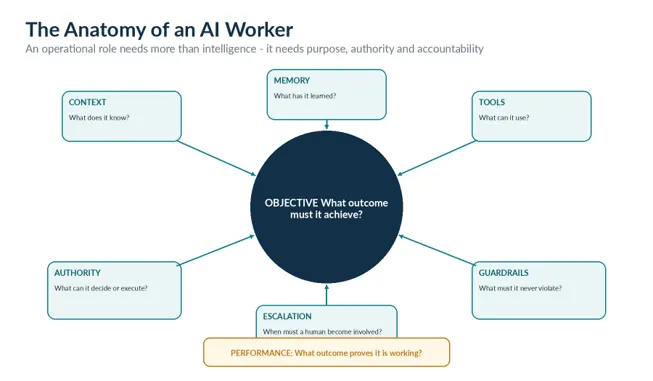
A role has an objective. It has responsibilities. It has access to information and tools. It has limits to its authority. It has performance expectations. It knows when it can act and when it must escalate. It collaborates with other roles to achieve a larger outcome.
When an AI system begins to possess these characteristics, it stops behaving only like a feature. It begins to behave like a member of the operating model.
This does not make the AI worker an employee in the legal or human sense. It remains software. The term 'AI worker' is an operating metaphor, but it is an important one because it changes how the enterprise designs, governs and measures the technology.
If leaders continue to treat AI workers as application features, they will focus on functionality. If they treat them as operating roles, they will begin asking more consequential questions.
• What work should this AI worker own?
• What decisions can it make?
• Which systems can it access?
• What policies must it follow?
• How will its performance be measured?
• Who is accountable for its actions?
• How does it collaborate with people and other AI workers?
Those are not conventional software implementation questions. They are questions of organizational design.
What Makes an AI System an AI Worker?
Not every model, chatbot or automated workflow should be called an AI worker.
A forecast model that produces a number is not an AI worker. A chatbot that answers questions but cannot take action is not an AI worker. A fixed workflow that moves data from one application to another is automation, but it is not necessarily an AI worker.
An AI worker combines several capabilities into a persistent operating role.
It has an objective. A Demand Analyst may be responsible for identifying meaningful deviations before they become forecast failures. An Inventory Strategist may be responsible for balancing working capital and service across the network. A Dispatch Planner may be responsible for generating the best feasible movement plan under cost, capacity and service constraints.
It has context. It understands more than the transaction directly in front of it. It can consider historical performance, current conditions, business priorities, policies, customer commitments and related operational constraints.
It has tools. It can read information from enterprise systems, run models, trigger workflows, communicate with people, prepare transactions and, where authorized, execute actions.
It has memory. It remembers prior recommendations, human overrides, recurring exceptions and the outcomes produced by earlier decisions.
It has authority. The authority may be limited, but it is explicit. The AI worker knows which actions it can perform automatically, which require approval and which are prohibited.
It has accountability mechanisms. Its actions are logged. Its reasoning can be reviewed. Its decisions can be traced to the signals, policies and assumptions that shaped them.
Finally, it has performance measures. It is evaluated not on how often employees interact with it, but on whether it improves the outcome for which it is responsible.
This last distinction is especially important. Application success has traditionally been measured through adoption, usage and process compliance. AI-worker performance must be measured through decision quality, intervention reduction, response speed and business outcomes.
The AI Workforce Will Not Be One Giant Agent
Enterprises divide human work into roles because different responsibilities require different expertise, objectives and authority. The same principle applies to AI.
A Demand Analyst should focus on demand behaviour, forecast deviations and market signals. An Inventory Strategist should focus on stock positioning, service risk and working capital. A Capacity Planner should understand bottlenecks, production feasibility and resource utilization. A Dispatch Planner should focus on orders, vehicles, routes, costs and delivery commitments.
These roles need to collaborate, but they should not necessarily become one indistinguishable intelligence.
There are several reasons for this separation. The first is accountability. It should be possible to identify which agent made a recommendation, what objective it was optimizing and which information it used.
The second is control. Different roles require different access rights and decision boundaries. An Inventory Strategist may recommend repositioning stock but should not automatically amend a production schedule unless that authority has been explicitly granted.
The third is specialization. An agent built around a clearly defined operational responsibility can be trained, tested and improved against that responsibility.
The fourth is organizational alignment. Enterprises already understand role-based accountability. Designing corresponding AI roles provides a more manageable bridge from the current operating model to the autonomous enterprise.
The future is therefore more likely to consist of coordinated AI-worker squads than one all-powerful agent. Each AI worker contributes a specialist perspective. An orchestration layer brings those perspectives together and ensures that the final decision serves the enterprise outcome rather than the interests of a single function.
A Supply-Chain Event Through the Eyes of an AI Workforce
Consider a consumer-products company preparing for a major festive sales period.
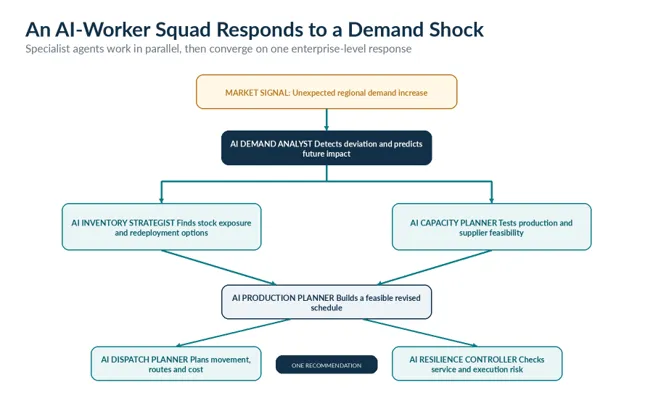
At 8:10 on a Monday morning, the Demand Analyst detects that orders for a product category are accelerating faster than the approved forecast. The increase is concentrated in two regions and appears to be linked to stronger-than-expected promotional response.
In a traditional operating model, the demand planner may notice the variance in a dashboard. The planner investigates, updates a spreadsheet and informs the supply-planning team. Inventory checks availability. Manufacturing assesses whether production can be increased. Procurement confirms material availability. Logistics evaluates additional capacity. Managers align priorities and seek approval for the revised plan.
The process may work, but it depends on sequential human coordination.
In an AI-workforce augmented model, the event moves differently. The Demand Analyst quantifies the deviation and estimates how the pattern is likely to develop. It passes the scenario to the Inventory Strategist, which identifies where stockouts are likely to occur and where excess inventory may be available for redeployment.
The Capacity Planner assesses whether production can be increased within current material, labour and line constraints. The Production Planner evaluates resequencing options and identifies the impact on other customer commitments.
The Dispatch Planner models the vehicles, routes and additional freight capacity required to reposition inventory. The Resilience Controller examines supplier, service and execution risks across the proposed response.
The agents then contribute to a coordinated recommendation. The enterprise can redeploy available stock immediately, increase production in the following cycle, protect priority customers and book additional logistics capacity only where the revenue and service risk justifies the cost.
If these actions fall within policy, they can be initiated automatically. If a strategic trade-off is required, leadership receives one consolidated decision with the relevant implications.
The human planner does not spend the morning collecting information and arranging alignment. The planner reviews the proposed response, challenges assumptions where necessary and applies judgment to the decisions that genuinely require it.
The enterprise does not remove the planner from the process. It removes much of the mechanical coordination surrounding the planner.
From a Chain of Handoffs to a Network of Decisions
Traditional enterprises often operate as chains of handoffs. Sales communicates demand to Planning. Planning communicates requirements to Procurement and Manufacturing. Manufacturing communicates output to Warehousing. Warehousing coordinates with Logistics. Logistics updates Customer Service.
Each function contributes necessary expertise. The problem is that the expertise is often activated sequentially. Work moves through the organization one handoff, meeting and escalation at a time.
AI workers allow the organization to operate more like a network. Multiple agents can examine the same event simultaneously from different perspectives. They can share context immediately. They can evaluate thousands of alternatives without waiting for a scheduled meeting. The orchestration layer can reconcile their objectives against enterprise-level policies and priorities.
This changes the meaning of coordination. Coordination is no longer primarily a calendar activity. It becomes a continuous computational capability.
Meetings do not disappear, but their purpose changes. People meet less often to exchange status and reconcile information. They meet to evaluate policy, challenge assumptions, resolve strategic trade-offs and improve the system.
Your Next Org Chart May Need Two Views
The conventional org chart is designed to answer one question: Who is accountable for whom?
The autonomous enterprise requires a second view: Who or what is responsible for which outcome?
The first view remains important. Companies still need legal accountability, people management, reporting structures and leadership responsibilities.
The second view reveals the operating system. It shows the human roles and AI roles involved in fulfilling a customer promise. It shows which systems provide information. It shows which agents monitor risks, make recommendations and initiate actions. It shows where decision rights sit and when escalation occurs.
A future supply-chain organization may therefore have a human organizational chart and an AI-workforce map.
The human chart could show the Chief Supply Chain Officer, planning leader, procurement leader, manufacturing leader and logistics leader. The AI-workforce map could show the Demand Analyst, Inventory Strategist, Capacity Planner, Production Planner, Network Planner, Warehouse Orchestrator, Dispatch Planner, Visibility Controller, Resilience Controller and Settlement Auditor.
The two structures overlap but are not identical. Human teams remain organized partly around expertise and accountability. AI workers can operate horizontally across those functional boundaries.
This is why the AI workforce may be invisible on the org chart but highly visible in the flow of work.
The AI Worker Needs a Job Description
Enterprises should not deploy AI workers with vague instructions such as 'help the planning team' or 'improve logistics.'
A human role becomes effective when its responsibilities, authority and success measures are clear. An AI-worker role requires the same discipline.
A proper AI-worker job description should answer several questions: What outcome does the role own? What signals must it monitor? Which systems and information can it access? Which models and tools can it use? Which actions can it recommend? Which actions can it execute? What conditions require escalation? Which policies constrain its behaviour? Which human role is accountable for its operation? How will the quality of its decisions be assessed?
Consider an AI Inventory Strategist. Its objective may be to protect service while minimizing inventory and working-capital exposure across the network. Its inputs could include demand forecasts, lead times, current inventory, open orders, supplier performance and service policies.
Its responsibilities may include identifying stockout and excess risks, evaluating safety-stock requirements, recommending redeployment and simulating replenishment scenarios.
Its authority may permit it to initiate stock transfers below a defined value when service at the sending location remains protected. Transfers affecting strategic customers, significant financial exposure or contractual commitments may require human approval.
Its performance could be assessed through service levels, working-capital reduction, stockout frequency, excess inventory, recommendation acceptance and the quality of its escalations.
This is more than configuration. It is the design of a digital operating role.
Managers Will Lead Hybrid Teams
The rise of AI workers does not make managers irrelevant. It gives them a new category of responsibility. Managers will increasingly lead hybrid teams composed of people and AI workers.
They will continue to coach employees, allocate human talent, build culture and manage performance. They will also define AI-worker objectives, review decision quality, adjust policies, approve expanded authority and intervene when the system encounters situations outside its competence.
This creates a different managerial rhythm. A manager may review why the Dispatch Planner repeatedly selected premium transportation for a particular lane. The issue may not be the agent's performance. The underlying delivery policy may be too strict, the contracted fleet may be insufficient, or the customer prioritization logic may be outdated.
A planning leader may examine why the Demand Analyst's recommendations are frequently overridden in one product category. The cause may be a missing market signal, an inappropriate model or local knowledge that has not yet been incorporated into enterprise memory.
The manager's role shifts from supervising every action to improving the system that produces actions.
In this model, management involves three connected responsibilities:
MANAGING PEOPLE | Developing capability, motivation, judgment and collaboration. |
|---|---|
MANAGING AI WORKERS | Defining roles, authority, policies and performance expectations. |
MANAGING THE INTERACTION | Deciding which work should remain human, which should be AI-led and where collaboration produces the best result. |
The future manager is not simply a people manager. The future manager is an operating-system designer.
AI-Worker Performance Cannot Be Measured Like Software Usage
Many enterprise-technology programmes measure success through logins, active users, dashboard views, transactions processed and workflow adoption.
These metrics may be useful for applications. They are insufficient for AI workers.
An AI worker that requires frequent human interaction may be less effective than one that quietly resolves routine situations. High usage is not necessarily the objective. The objective is better operational performance.
AI-worker scorecards should therefore focus on outcomes and decision quality.
An AI Demand Analyst might be measured on how early it identifies meaningful changes, how accurately it distinguishes signals from noise and whether its recommendations improve forecast performance.
An AI Dispatch Planner might be measured on plan feasibility, vehicle utilization, cost, service adherence, planning time and the frequency of manual correction.
A Resilience Controller might be measured on the number of disruptions detected before impact, time to recovery, prevented service failures and the quality of escalations.
Across all roles, enterprises should also track policy adherence, explainability, human override rates, autonomous-resolution rates and outcome improvement over time.
AI Workers Need Onboarding Too
A new employee is rarely given complete authority on the first day. The employee learns the organization, observes experienced colleagues, receives feedback and earns trust.
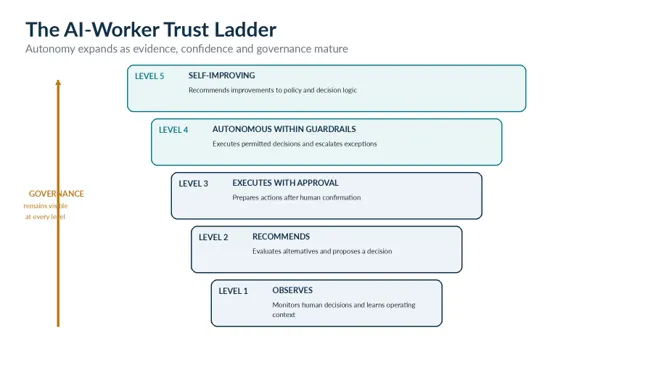
AI workers should follow a comparable progression.
Initially, the agent may operate in observation mode. It monitors decisions and shows what it would have recommended without affecting execution.
It can then move to recommendation mode, where it presents alternatives and reasoning while humans retain decision authority.
The next stage is assisted execution. The agent prepares actions, but a human approves them before release.
Only after sufficient evidence has been accumulated should the AI worker receive authority to act independently within defined guardrails.
Even then, autonomy should not be permanent or unconditional. Authority may vary by location, product category, customer segment, financial exposure or operational circumstance.
An AI worker might be trusted to manage routine replenishment for stable products while remaining advisory for new product launches. It might autonomously select approved carriers on established lanes but require approval for a new international route.
The enterprise should therefore think of autonomy as earned decision rights, not as a binary technology setting.
The AI Workforce Needs an Enterprise Memory
Human employees rely on more than transactional data. They remember why a customer was prioritized, how a supplier behaved during a previous disruption, why a policy was changed and which response worked in a comparable situation.
An AI workforce needs a similar institutional memory.
It must know not only what happened, but why earlier decisions were made and what followed. It should remember which recommendations were accepted or overridden, what assumptions proved inaccurate, which policies created unintended consequences and how the enterprise responded to earlier exceptions.
Without memory, AI workers repeatedly approach situations as if they were new. With memory, their decisions can improve cumulatively.
Enterprise memory also supports collaboration between agents. A Resilience Controller can inform the Sourcing Strategist that a supplier's recent reliability pattern has changed. A Demand Analyst can provide the Inventory Strategist with the reasons behind a forecast revision. A Dispatch Planner can learn from repeated manual route changes made by experienced planners.
This is how separate AI roles begin to function as a workforce rather than a collection of isolated tools. They share context. They learn from one another. They build on prior outcomes. They improve how the enterprise responds.
Avoid Creating Digital Silos
There is a significant risk that enterprises will reproduce their existing functional silos in AI form.
Procurement may deploy its own agent. Manufacturing may deploy another. Logistics may deploy several more. Each agent may optimize its own functional objective, use a separate data foundation and operate under different policies.
The organization could end up with faster local decisions and worse enterprise outcomes.
A procurement agent may reduce purchase cost by ordering larger quantities. An inventory agent may then struggle with excess stock. A manufacturing agent may maximize capacity utilization, while the logistics agent faces unnecessary movement and the finance agent sees working capital increase.
Each AI worker may be successful according to its own metric. The enterprise may still fail.
This is why AI-workforce orchestration matters. The agents need role clarity, but they also need a shared understanding of enterprise priorities. Their recommendations must be reconciled against customer outcomes, financial implications, service commitments and risk.
Autonomy without orchestration creates digital fragmentation. Orchestration without policy creates uncontrolled intelligence. Policy without clear accountability creates ambiguity.
The AI workforce requires all three: specialist roles, enterprise orchestration and human-defined governance.
The Responsibility Will Extend Beyond IT
The AI workforce cannot be owned only by the technology department.
IT will remain responsible for architecture, security, access, reliability and integration. But the business must own the operating role.
A supply-chain leader should define what the Inventory Strategist is trying to achieve. Finance should contribute the working-capital and margin policies it must respect. Risk and compliance teams should define prohibited actions and escalation thresholds. Operational managers should review decision quality and provide feedback. Human Resources may eventually help redesign roles, skills and management expectations around hybrid teams.
The Chief Financial Officer may also need to rethink investment decisions. AI workers may not appear as headcount, but they create measurable productive capacity. The enterprise will need ways to compare the cost and value of digital labour with traditional hiring, outsourcing and software investment.
Boards will need to understand where autonomous decision rights exist and how they are governed. Audit teams will need access to decision lineage. Leadership teams will need visibility into where human judgment remains essential and where the organization is still dependent on manual coordination.
The AI workforce is therefore not an IT deployment. It is a new enterprise capability requiring cross-functional ownership.
What Can Go Wrong?
The promise of an AI workforce is significant, but so are the risks of careless deployment.
An AI worker can scale poor policy. If an enterprise has conflicting incentives, the agent may execute those conflicts more quickly.
An AI worker can become overconfident. If uncertainty is not properly represented, recommendations may appear more definitive than the evidence supports.
An AI worker can operate with incomplete context. Decisions may be technically logical but commercially or culturally inappropriate.
An AI worker can create accountability gaps. If nobody clearly owns the role, people may blame the system while continuing to depend on it.
An AI worker can become obsolete. Models, policies and operating assumptions must evolve as markets and business priorities change.
An AI worker can also create a new form of shadow organization. Different teams may deploy overlapping agents with inconsistent authority, duplicated responsibilities and incompatible objectives.
These risks are not arguments against the AI workforce. They are arguments for managing it as a workforce rather than treating it as a collection of software experiments.
Roles must be explicit. Authority must be bounded. Actions must be traceable. Performance must be measured. Policies must have owners. Humans must remain accountable.
The rise of AI workers is often framed as a discussion about replacing people. That framing misses the larger transformation.
The AI workforce is most valuable when it absorbs work that consumes human attention without requiring uniquely human capability: collecting status updates, reconciling information, monitoring routine exceptions, comparing known alternatives, preparing standard plans, following up on tasks and executing repetitive decisions within clear boundaries.
As this work shifts to AI, human roles can move toward judgment, creativity, relationship-building, negotiation, ethics, strategy, innovation and complex problem-solving.
The planner becomes less of a spreadsheet operator and more of a decision architect. The logistics manager becomes less of an escalation coordinator and more of a network strategist. The procurement leader becomes less focused on individual approvals and more focused on resilience and supplier ecosystems. The functional manager spends less time moving information and more time developing people and improving the system.
The enterprise may employ AI workers, but it still depends on human leadership to determine what outcomes matter, what trade-offs are acceptable and what kind of organization it wants to become.
Final Thought
The enterprise org chart was designed to represent a workforce made entirely of people. That assumption is no longer complete.
A new workforce is emerging alongside the human organization. It can monitor operations continuously, interpret signals across systems, evaluate alternatives, coordinate decisions and execute within defined boundaries.
This workforce will not appear in payroll reports. It may not appear in employee directories. It may not sit neatly inside existing departments. But it will increasingly influence how work gets done.
The important question is therefore not whether enterprises will adopt AI agents. Many already are.
The more important questions are:
• What roles will these agents perform?
• How will they collaborate?
• What authority will they possess?
• How will they be governed?
• How will their performance be measured?
• How will people and AI workers operate as one enterprise?
The companies that answer these questions early will not simply automate more tasks. They will build a fundamentally different operating model.
One in which human leaders define direction. Human managers design policies and improve the system. Human employees apply creativity, empathy and judgment. AI workers monitor, analyse, coordinate and execute. Enterprise systems provide the transactional foundation. And an orchestration layer brings the entire workforce together around shared outcomes.
Your org chart may still show every employee. It may no longer show everyone doing the work.
Share this article