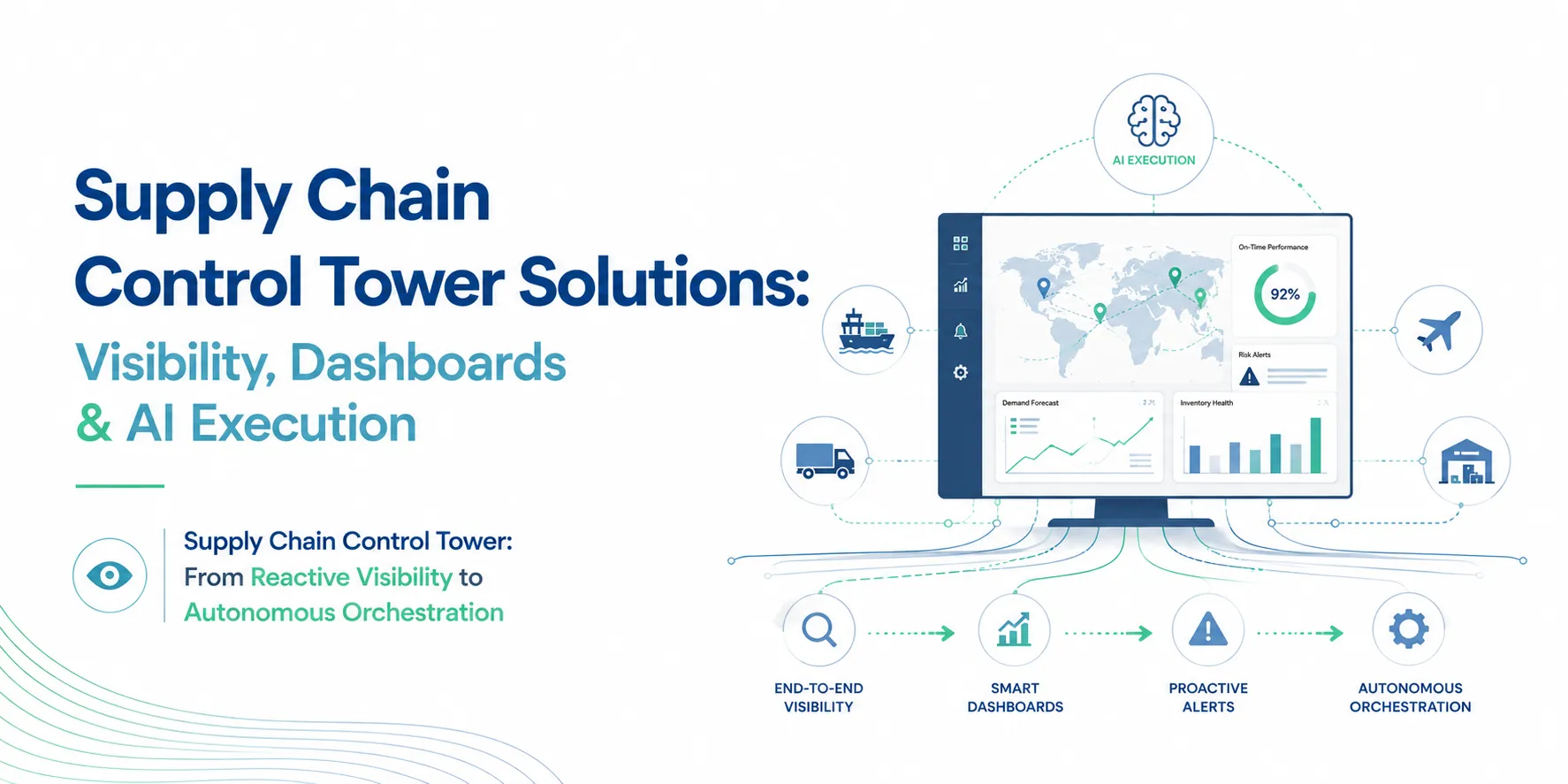
Many enterprises think they operate a true digital supply chain control tower. They buy new visibility software. They set up huge screens in a central office showing every truck on the highway and every ship crossing the ocean. Everything looks perfect.
Then, a sudden port strike or severe winter storm hits. What happens next?
The logistics team still panics. The big screens flash red with delay alerts. Human workers spend hours making phone calls to carriers. They update Excel sheets by hand. They pay massive markups for last-minute spot market trucks.
What is a supply chain control tower?
A supply chain control tower is a central digital hub that links your entire logistics network into one single pane of glass. It captures real-time data across demand forecasting, inventory levels, and transport execution.
A truly digital control tower goes far beyond basic tracking. It uses AI to predict disruptions, sense real-world limits, and trigger automated fixes. It connects your factory floors, your carriers, and your warehouses into one smart, self-correcting loop.
The Evolution: Three Generations of Control Tower
Where does your stack sit?
- Gen 1
Visibility control tower
Tracks raw materials and finished goods in transit. Puts dots on a map. Good at handling multimodal freight, but it only reports the news, it does not change the outcome.
- Gen 2
Planning control tower
Connects to demand forecasts and inventory levels. Runs what-if scenarios so you can see how a sudden spike in customer orders will impact truck capacity needs next week.
- Gen 3
Cognitive AI Control Tower
Visibility feeds directly into planning and execution. A delayed truck triggers instant re-routing, schedule updates, and dock changes with zero human touch. The modern standard.
Top advantages of control tower adoption
Automated exception fixes
Predicts delays days in advance and triggers smart playbooks to reroute freight. Saves millions in missed delivery penalties and keeps assembly lines running.
Lower inventory buffer costs
When transit times become trustworthy, you can safely lower safety stock — freeing up millions in working capital.
Higher vehicle fill rates
Planners see all network constraints in real time and the system builds denser, more profitable loads — cutting total trucks hired each month.
Reduced freight leakage
Tracking data feeds the finance tools directly, matching ePOD to the carrier bill and stopping hidden overcharges and duplicate billing.
Why do so many control towers fail?
If the benefits are so clear, why do rollouts fail so often? The implementation challenges usually come from bad data and rigid software. Enterprises buy a standalone tracking tool and try to bolt it onto a heavy, older ERP system like SAP or Oracle.
When you do this, you create alert fatigue. Your global control tower becomes just an inbox full of warnings. If the tower tells you a truck is late but cannot automatically fix the dock schedule, it fails.
The blueprint: five mandates for an AI-native intelligence layer
To overcome structural failures, enterprises must rethink their approach. The goal is no longer to buy a software tool that monitors logistics — the goal is to build an execution-grade intelligence layer that closes the loop between planning, tracking, and finance. A modern control tower must deliver on five specific operational mandates.
1. True multi-modal visibility on one dashboard
Ocean, rail, and road freight in a single pane of glass — inbound and outbound — with active, delayed, and untracked shipments visible without switching tabs.
2. Triple-redundancy tracking
GPS, SIM-based tracking, and highway toll milestones. If one method fails, the system falls back to another. Removable magnetic GPS supports ad-hoc market vehicles too.
3. AI-powered ETA predictions
95% accuracy on arrival times by analysing loading delays, route stoppages, overspeeding, and night driving. Flags likely-delayed shipments proactively.
4. Automated exception playbooks
Auto-raises tickets, escalates via Email / WhatsApp / SMS, classifies exceptions, and triggers playbook-based resolutions — including weather-based reroutes.
5. Prompt-based operations via agentic AI
CADDIE turns natural language questions into instant answers. "Which inbound shipments to the Ohio plant face weather delays today?" — answered in Teams or WhatsApp without a dashboard.
Overcoming integration friction through ecosystems
Even with the most advanced AI control tower, technology alone does not drive transformation. Integration failure remains the biggest hurdle for enterprises. When you force an AI-native platform to talk to a rigid, twenty-year-old ERP system, the data models clash and the project stalls.
You need the intelligence of an AI platform paired with the execution power of a digital transformation partner. Enmovil provides the AI intelligence layer while strategic partners like SRM Tech provide the deep integration engine — mapping complex data flows, handling change management, and moving the enterprise from intent to execution with zero friction.
The final verdict: predict, plan, execute
A supply chain control tower is not a screen on a wall. It is a fundamental shift in how a business operates. If your dispatch planners are using an advanced algorithm but your warehouse team still reschedules docks manually based on phone calls, you are optimising a silo. You do not have a control tower — you have a very expensive map.
The future belongs to enterprises that treat logistics as a continuous loop. They predict the demand. They plan dispatch around real-world constraints. They track execution without blind spots. They resolve exceptions autonomously. They settle the freight bill systematically.
Are your logistics technologies talking to each other to resolve exceptions automatically? Or are your people still acting as the manual integration layer between disconnected screens?
Frequently asked questions
What is a supply chain control tower?
What are the challenges in implementing a control tower?
What are the benefits of a control tower?
How does Enmovil ensure accurate tracking?
Share this article