For two decades, supply chain leaders have chased the same thing.
Visibility.
See the shipment. See the inventory. See the exception. The promise was seductive: if we can just see everything, we can manage everything.
And yet here we are. 76% of manufacturers still say their supply chain visibility is limited. Despite years of investment. Despite dashboards multiplying across every screen in the operations centre.
Something is wrong with the model.
Because visibility on its own was never the answer. It was always just the beginning.
We Built Dashboards. We Needed Decisions.
Walk into any large enterprise running supply chain operations today. They have dashboards. Multiple dashboards. Shipment tracking. Inventory. Supplier performance. Exceptions. Sometimes dashboards to navigate to other dashboards.
And yet the transport coordinator is still on the phone with the carrier. The supply planner is still reconciling three data sources. The operations manager is still in a spreadsheet the morning after a disruption.
Seeing a problem is not the same as solving it. Enterprises have spent an enormous amount of money achieving exactly that — the ability to see problems, faster, in better colours, on more screens.
Visibility without action is not a capability. It is overhead.
The Three Layers Nobody Talks About Honestly
When we talk about supply chain visibility, we are actually talking about three very different things. Confusing them is why so many implementations disappoint.
Layer One — Transportation Visibility
Track the shipment. Know where the truck is. Necessary. Not sufficient.
Layer Two — Operational Visibility:
Connect in-transit events to inventory positions, demand signals, and customer commitments. A delay means nothing in isolation. It means everything when connected to a production schedule.
Layer Three — Ecosystem Visibility:
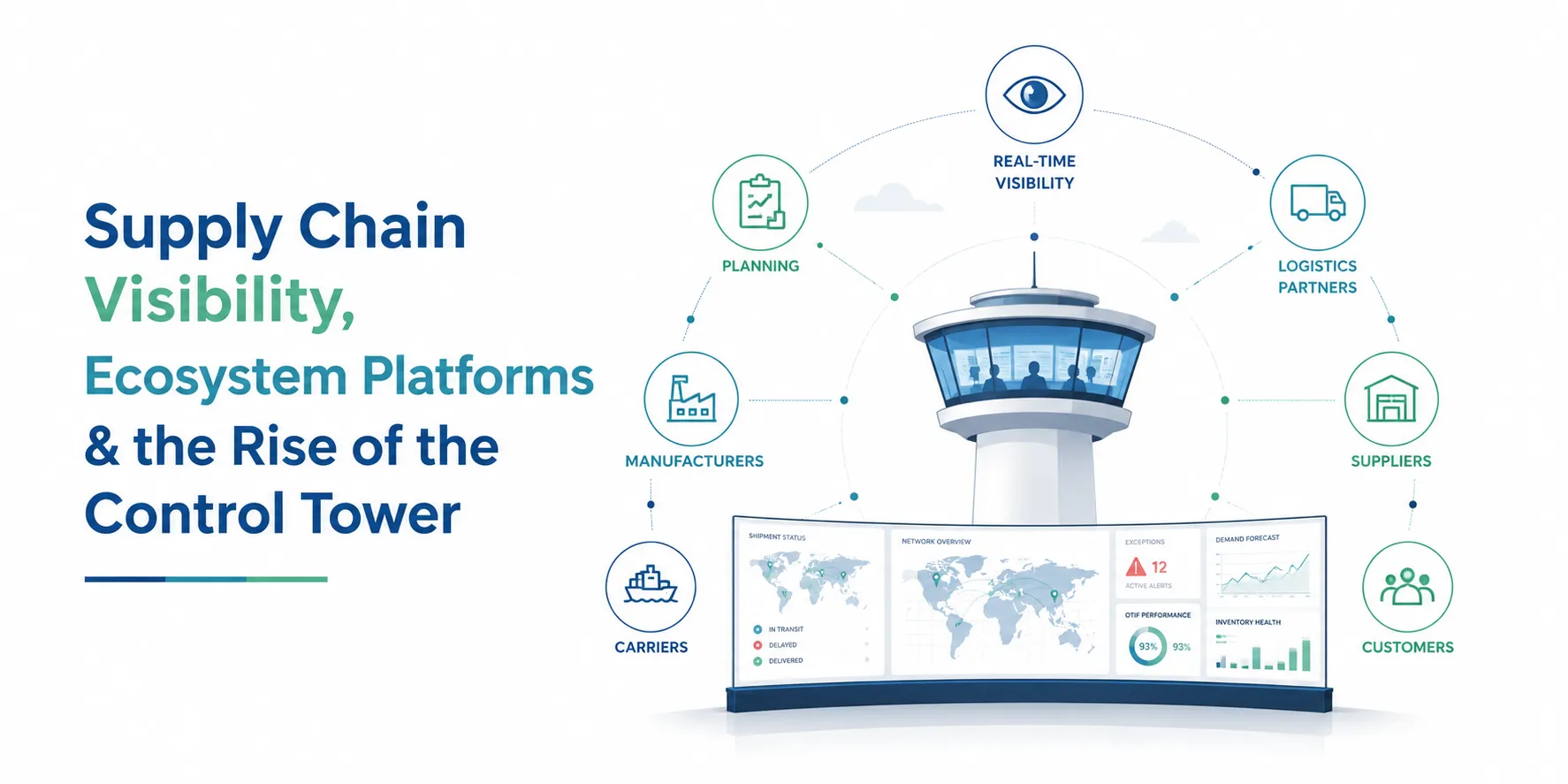
Your suppliers see what you see. Your logistics partners operate from the same signals. Decisions happen across company boundaries, not just within them.
Most investments have been concentrated at Layer One. Layer Three true ecosystem connectivity is where the real transformation lives.
The Control Tower Has Been Misunderstood
The term “control tower” has been in supply chain conversations for years. And it has meant different things to different people at different times — which is exactly why it has frustrated so many who invested in it.
For most enterprises, a control tower has been a dashboard with a more impressive name. A place where alerts accumulate. Where humans sit and watch. Where exception reports are generated and decisions happen somewhere else, by someone else, later.
That version is not wrong. It is simply incomplete.
Here is the honest map of where enterprises actually are — and what each stage truly represents:
Stage | Where You Are | What It Actually Means |
|---|---|---|
Stage 1 | Data Darkness | Shipments tracked via calls and spreadsheets. Disruptions discovered after they become crises. |
Stage 2 | Internal Visibility | ERP, WMS, TMS connected. You can see inside your walls. Goods vanish the moment they leave. |
Stage 3 | Extended Visibility | Real-time tracking connects in-transit freight. You know where things are. Not why they’re going wrong. |
Stage 4 | Ecosystem Intelligence | Suppliers, partners, customers on a shared data layer. Signals flow in real time across company boundaries. |
Stage 5 | Autonomous Orchestration | The control tower doesn’t just sense and suggest. It acts — within governed guardrails, continuously, at scale. |
Most enterprises sit between Stage 2 and Stage 3. Stage 5 autonomous orchestration, is where the separation between supply chain leaders and the rest will happen over the next three years
Autonomy Is Not a Switch. It Is What You Earn.
Autonomous operations are not achieved through a single implementation. They are earned, progressively, through governance, trust, and deliberate deployment.
The right progression follows a simple logic:
First, earn visibility. Know what is happening, in real time, across the network.
Then, earn recommendation. The system does not just show the problem. It tells you what to do about it.
Then, earn assisted execution. The system acts on decisions, with human approval. Trust builds, decision by decision.
Then, earn autonomy. The system acts within governed guardrails. Humans focus on exceptions and the decisions no algorithm should make alone.
Each stage is a proof point. Each stage earns the permission to go further.
Final Thought
Visibility was always a means, not an end. Ecosystem platforms and AI-powered control towers are the infrastructure that finally make faster decisions possible at scale.
The organizations leading the next decade will not be the ones who built the best dashboards. They will be the ones who moved from dashboards to decisions. From monitoring to orchestration. From reactive to autonomous.
Share this article