The delivery window is 6 AM. The dealer is waiting. Here's the sequence that determines whether you make it or not.
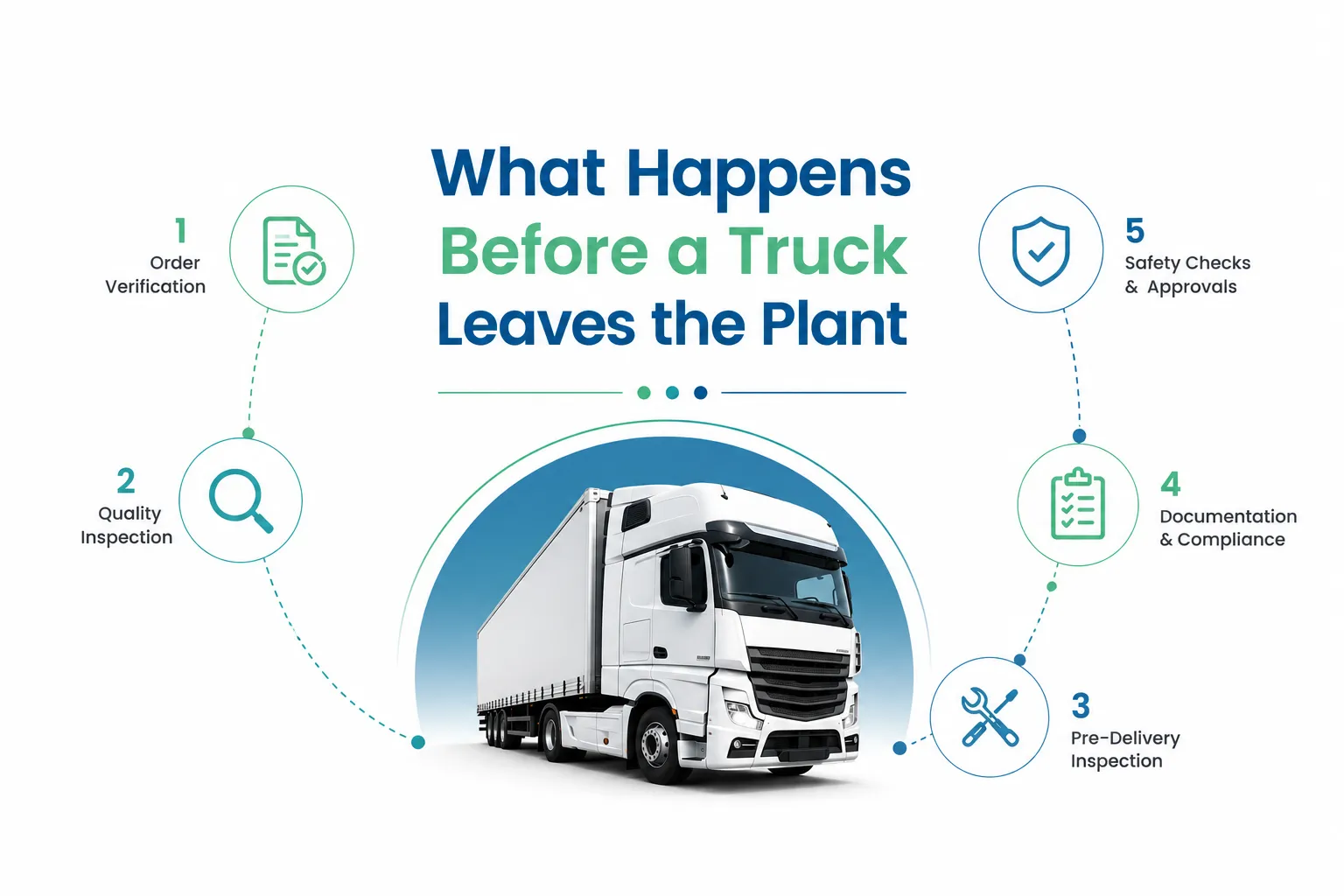
Most supply chain conversations begin at the point of dispatch. The decisions that determine on-time delivery, damage-free vehicles, and accurate invoicing are made before the truck ever moves. Inside the plant, there's a precise, pressure-tested sequence running in parallel. When even one part slips, the entire downstream chain absorbs the shock.
Here's what that sequence actually looks like.
Production Sign-Off: Nothing Moves Without It
Every vehicle that rolls off the assembly line receives a production completion sign-off, a system-level confirmation that the unit is built to specification. The VIN (Vehicle Identification Number), the unique 17-character identifier that follows a vehicle through its entire lifecycle, is logged, verified, and activated in the system.
No VIN confirmation, no yard entry. It's the first gate, and it's non-negotiable.
Quality Check: Pre-Delivery Inspection (PDI)
Before a vehicle touches the outbound yard, it goes through a PDI (Pre-Delivery Inspection), a structured quality checkpoint covering fluids, electricals, paint finish, tyre pressure, and functional tests.
In JIT (Just-In-Time) manufacturing environments, standard across automotive, there's zero buffer for post-dispatch corrections. A defect caught at PDI costs 30 minutes. The same defect caught at the dealer costs days, a return logistics cycle, and a damaged customer relationship. PDI is where quality risk is resolved before it becomes a logistics problem.
Staging Zone : Yard Management: Controlled Chaos, Made Precise
Post-PDI, vehicles stage in the outbound yard, a live, constantly shifting environment holding hundreds of units at any given time. A YMS (Yard Management System) tracks every vehicle by bay, row, and slot in real time.
Without YMS discipline, a yard of 600 vehicles becomes operationally blind. Truck loading gets delayed. Sequences break. TAT (Turnaround Time) inflates. The yard is not a parking lot. It's an active execution zone.
Load Planning: Sequence Is Everything
A car carrier isn't loaded randomly. Load planning accounts for dealer priority, drop sequence, vehicle dimensions, model mix, and physical load geometry on the transporter.
A misequenced load means the last dealer on the route gets unloaded first. Your OTIF (On Time In Full) metric drops. In high-volume plants, load planning is software-driven and optimised to the unit, because one wrong placement on a 10-car carrier creates a cascading sequence problem across three dealer locations
Driver Briefing and Documentation
The driver receives a formal dispatch briefing covering the route plan, delivery sequence, handling instructions, and a full documentation pack: CMR waybills, vehicle condition reports, and dealer acknowledgement sheets.
Every loaded unit is photographed. Every document is signed. This isn't bureaucracy. It's your legal and commercial proof chain. If a damage claim surfaces 500 kilometres away, this documentation is the difference between a resolved dispute and an unrecovered cost.
Gate Release: The Last Line of Defence
Gate clearance is the final checkpoint. Security cross-checks the load manifest against the YMS, verifies driver credentials, and confirms all documents are in order before the gate opens.
A missing unit discovered at the gate costs 20 minutes. The same unit discovered missing at the dealer costs a failed delivery, a return trip, and a blown SLA. Gate release is where every upstream action gets validated in one controlled moment.
Why This Process Breaks and What It Really Costs
Each of these six checkpoints generates data: VIN status, PDI flags, yard positions, load manifests, driver records, gate logs. In most plants today, that data lives in disconnected systems. An ERP here, a YMS there, a WhatsApp message to the transporter somewhere in between.
When something slips, a delayed PDI, a misequenced load, a documentation gap, response time depends on how fast a coordinator can manually cross-reference three systems and make a phone call. By then, the 6 AM window is already gone.
The Takeaway
Pre-departure execution is where delivery performance is won or lost. Every checkpoint in this process, from VIN sign-off to gate clearance, is a risk point. Risk that isn't caught inside the plant gets absorbed by the dealer, the customer, or your P&L.
The plants that consistently hit delivery windows aren't doing anything different in principle. They're running the same six checkpoints, but with systems that connect every data point to every decision in real time.
That's the difference between logging a problem and solving one before it leaves the yard.
From Visibility to Control. In Real Time.
See how Enmovil connects dispatch planning, live multimodal tracking, and automated freight settlement into a single closed loop, so your team resolves exceptions before they leave the yard.
Book a Live Walkthrough at www.enmovil.ai
Share this article