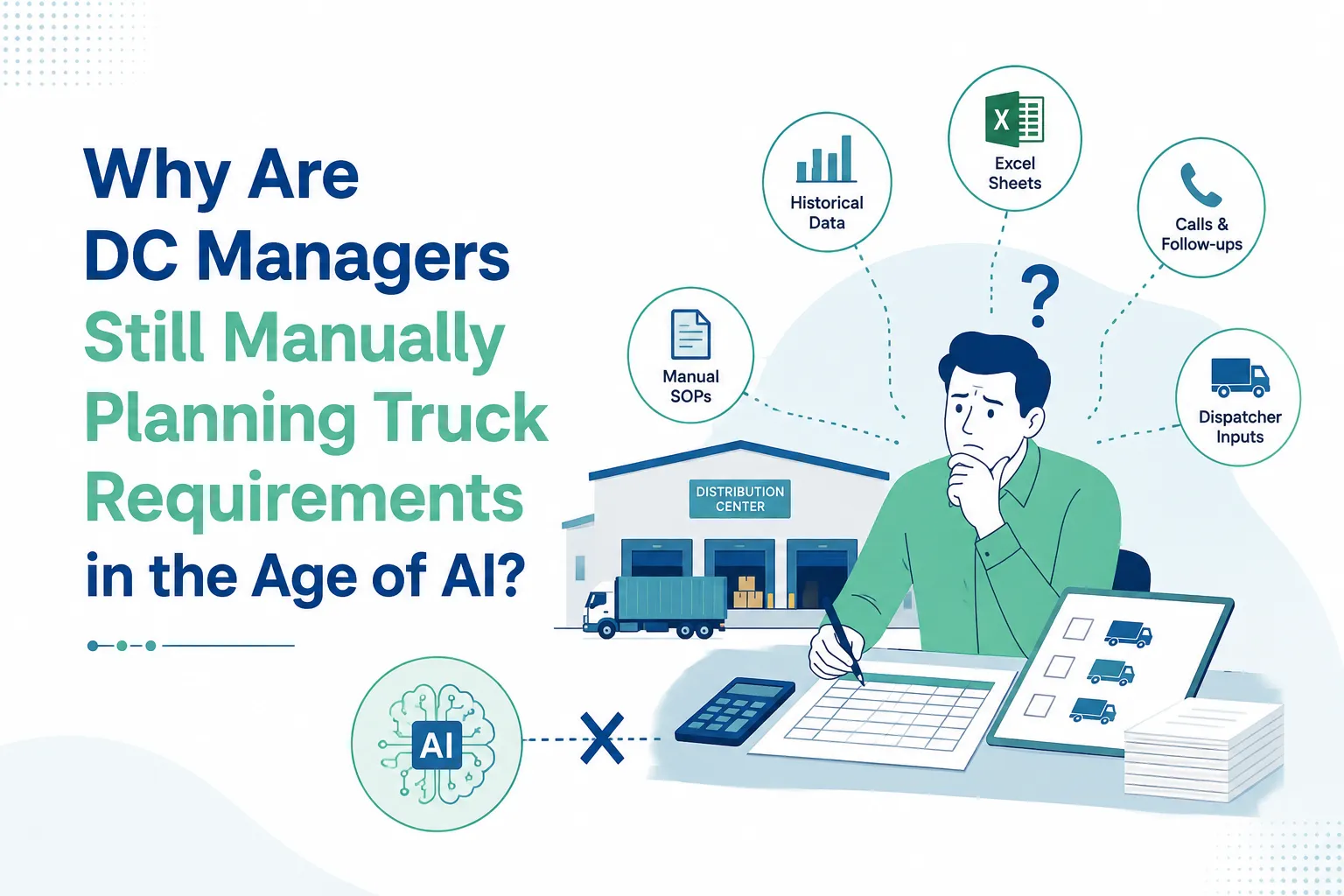
The 7 AM Guessing Game
Every morning, before the first truck leaves the yard, a DC manager somewhere is doing the same thing: counting pending orders, estimating volume, guessing at truck count, and working the phones to line up transporters. It's not a system decision. It's a person, a notepad or a spreadsheet, and years of institutional memory standing in for a planning engine.
This isn't a small-company problem. Recent buyer conversations with established distribution networks some running dozens of warehouses across multiple manufacturing plants reveal the same gap: vehicle selection and dispatch planning is still not automated by any tool. The process is entirely manual. Even where replenishment planning draws on years of historic sales trends, the final call on how many trucks, what size, and which route still comes down to a person's judgment each morning.
The same pattern shows up in mature single-plant operations too. One automotive component manufacturer running roughly 100 transport trips a day within a fixed 16-hour window operates on fixed routes, fixed pallet designs, and transporters contracted a full year in advance. Every disruption a late vendor dispatch, a weather delay, a driver issue gets absorbed by safety stock rather than replanned in real time.
Why Manual Truck Planning Breaks Down at Scale
It's Reactive, Not Predictive
A DC manager planning by hand can only react to what's already on the order sheet that morning. There's no forward view of tomorrow's volume spike, no early warning that a transporter is short two trucks this week, and no way to smooth demand across the day without physically calling around.
It Doesn't Account for Real Constraints
Truck planning isn't just "how many trucks." It's SLA delivery-point limits (often two to three stops per truck), variable vehicle capacities across a mixed fleet, loading-dock windows, and material-specific handling rules all of which a person has to hold in their head simultaneously, every single day, without error.
It Breaks the Moment Someone Is Out Sick
When truck planning lives in one person's head and one spreadsheet, the process has a single point of failure. A DC manager on leave, a sudden order surge, or a last-minute transporter cancellation turns a routine morning into a scramble because there's no system to fall back on, only tribal knowledge.
It Doesn't Scale With Order Volume Growth
A process that works at 40 daily dispatches starts to visibly strain at 100, and breaks down entirely past that. Manual planning has a hard ceiling not because the person managing it isn't capable, but because the number of variables to juggle grows faster than any one person can track by hand. Growth becomes a headcount problem instead of a systems problem.
How to Tell If This Is Costing You
Manual truck planning rarely announces itself as a crisis. It shows up as a pattern of small, recurring symptoms that most teams have simply learned to live with:
● Trucks are booked and then cancelled or re-booked same-day more than occasionally
● The same one or two people are the only ones who can "run" the morning dispatch process
● Transporter calls happen ad hoc rather than against a standing schedule
● There's no record of why a particular truck size or count was chosen on a given day
● Planning decisions get slower, not faster, as order volume grows month over month
None of these individually look like a crisis. Together, they describe a process that's one bad morning away from a missed dispatch.
What Automated Truck Requirement Planning Actually Looks Like
Demand-Linked Truck Advisory
Instead of estimating from memory, a dispatch plan can be generated directly from truck master data, material master data, payment confirmation status, and live stock availability with a system-generated truck advisory on exactly what to place and when.
Constraint-Aware Planning Windows
A dynamic planning window can hold partial loads until the next cycle specifically to build a full truck load, rather than dispatching a half-empty vehicle. And when no contracted truck is available, the system can automatically raise a spot RFQ instead of leaving a planner to make cold calls.
Auto-Selection Based on Material Type
The system can select the best-fit truck for an entire monthly plan based on what's actually being shipped factoring in material type, handling needs, and route so vehicle selection stops being a daily guess and becomes a standing, auditable rule.
Manual Planning vs. Automated Truck Advisory
The difference isn't just speed, it's what becomes possible once the decision is systematized:
● Manual: One person estimates truck count from memory and order sheets each morning → Automated: The system calculates truck requirement directly from live order and stock data
● Manual: Transporter calls happen reactively when a gap is discovered → Automated: Spot RFQs are raised automatically the moment contracted capacity falls short
● Manual: No record of why a decision was made → Automated: Every truck advisory is generated from an auditable, repeatable rule set
● Manual: Breaks down when the primary planner is unavailable → Automated: Runs consistently regardless of who's on shift
The Business Case
● Planner time reclaimed, hours spent on manual truck counting redirected to exception handling
● Fewer under- or over-trucked dispatches, and fewer last-minute transporter calls
● Faster reaction to demand spikes without waiting for a person to notice the pattern
● A repeatable, auditable process that survives staff turnover and leave days
Manual truck planning was a reasonable answer when order volumes were small and predictable. At current scale, it's a single person quietly carrying a decision that a connected system can make faster, more consistently, and without the morning scramble.
Frequently Asked Questions
What causes DC managers to still plan truck requirements manually?
Can truck requirement planning be automated without replacing the ERP?
What data does automated truck planning need to get started?
How long does it take to move from manual to automated truck planning?
Does this replace the DC manager's role?
Stop Guessing How Many Trucks You Need
The morning truck count doesn't have to live in one person's head. Manufacturers automating this step aren't replacing their ERP, they're adding a dispatch-planning layer that turns order data into a truck advisory before the first call to a transporter is even made.
Share this article